Sharing a flat works right up until somebody says "I think I paid more this month." Nobody is lying. The receipts are scattered across two banking apps, a group chat and a supermarket loyalty card, and the person who remembers loudest usually wins.
The fix is not another app that everyone has to install. It is agreeing on one splitting rule up front, writing every shared cost down as it happens, and doing the arithmetic once a month instead of arguing about it.
The rulePick a splitting rule before you move in
Most of the resentment in shared housing comes from splitting everything evenly when the situation is not even. There are four rules worth knowing, and only one of them is "split it down the middle".
Even split. Everyone pays the same. Honest and quick, and the right answer when the rooms and incomes are broadly comparable. It stops being fair the moment one bedroom is half the size of the other.
By room size. Take each room's floor area as a share of the total private space, and split the rent in those proportions. Common areas are shared, so leave them out of the calculation entirely. If your room is 14 m2 and your flatmate's is 10 m2, you pay 58% of the rent and they pay 42%.
By income. Each person pays the same share of what they earn rather than the same number. On a 3,000 and a 5,000 monthly income splitting 2,000 of rent, that is 750 and 1,250 — both of you are handing over 25%. This is the rule to reach for when one person is a student and the other is not, and it needs an honest conversation to work.
Per item. Rent by room size, utilities evenly, groceries by who actually eats them. More admin, but it is the only rule that survives one person being away half the month.
Whichever rule you choose, write it down in the group chat the day you agree it. Not because anyone will cheat, but because in four months nobody will remember whether the internet was supposed to be even or by income.
TrackingTrack costs as they happen, not at the end of the month
This is where most households actually fail. The rule is fine; the record does not exist.
You need three fields per shared cost, and nothing more: what it was, how much, and who paid. A running note works. A shared spreadsheet works. What does not work is trying to reconstruct a month from bank statements, because half the shared spending is on a card that also bought a jacket and a coffee.
A few things worth agreeing on at the same time:
- One person pays each recurring bill. Splitting a single electricity bill four ways at source creates four payment failures instead of one. Let one name sit on the account and settle it in the monthly reckoning.
- Set a "just pay it" threshold. Below some number — five, ten, whatever suits — nobody logs anything. Washing-up liquid is not worth a ledger entry, and a household that tracks it will stop tracking anything within a fortnight.
- Log it in the shop, not later. The entry takes eight seconds standing at the till and twenty minutes at the end of the month.
Settling upDo the settle-up once, properly
Here is the part people get wrong. Once you have a list of who paid what, the goal is not for everyone to pay everyone back. The goal is the smallest number of transfers that leaves everybody square.
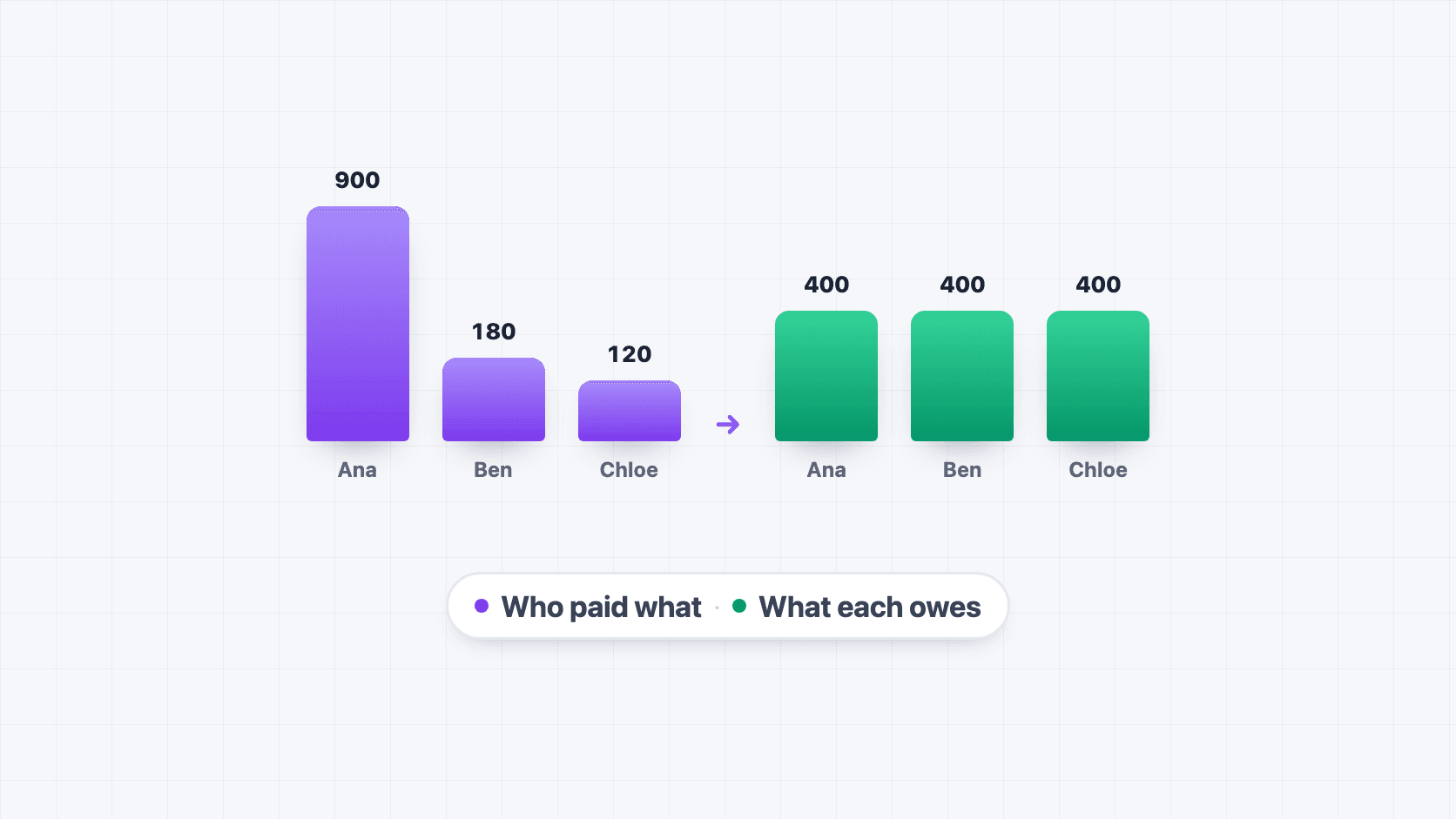
The maths is simpler than it looks. Take three flatmates who agreed on an even split:
- Ana paid 900 for rent
- Ben paid 180 for utilities
- Chloe paid 120 for groceries
Total shared spending is 1,200, so each person's fair share is 400.
Now compute each person's balance as what they paid minus what they owed:
- Ana: 900 − 400 = +500 (she is owed 500)
- Ben: 180 − 400 = −220 (he owes 220)
- Chloe: 120 − 400 = −280 (she owes 280)
The balances always add to zero. If they do not, something is missing from the list.
Then settle by matching the biggest debtor to the biggest creditor until everyone is at zero. Chloe sends Ana 280. Ben sends Ana 220. Two transfers, done — not the six you would get if everyone paid everyone.
With four or more people this gets fiddly quickly, which is exactly the sort of arithmetic worth handing to a split expenses calculator. Enter who paid what, and it returns the minimum set of transfers.
Send a linkThe part that actually ends arguments: send a link, not a screenshot
A screenshot of your calculation is your version of events. A link that everyone can open is a shared one.
Our Split Expenses Calculator produces a link that your flatmates can open without creating an account, installing anything, or handing over an email address. They see the same numbers you do, including who paid what and how the shares were worked out. Somebody who wants to check the arithmetic can check it, rather than taking your word for it in a group chat.
That matters more than it sounds. Most flat-share disputes are not about money, they are about the feeling that the sums happened somewhere you could not see.
Awkward casesHandle the awkward cases explicitly
Someone moves out mid-month. Prorate by nights, not by an eyeballed fraction. Eleven nights of a thirty-night month is 11/30 of that person's share — roughly 37%, not "about a third, call it 30".
A guest stays for three weeks. Nobody enjoys this conversation, so have it before it happens: agree at the start how long a guest can stay before they start contributing to utilities and shared groceries.
Someone genuinely cannot pay this month. Write down what is owed and when it will be paid. A stated debt with a date is a manageable thing between friends. An unstated one becomes a grudge.
Wildly different usage. One flatmate works from home five days a week and the other is in an office. Heating and electricity are not being consumed evenly, and everyone knows it. Either weight those two bills or accept the difference out loud — what corrodes a household is pretending not to notice.
Monthly routineA workable monthly routine
- 01Agree the rule once, when you move in. Write it in the chat.
- 02Log every shared cost as it happens — item, amount, who paid.
- 03On the same day each month, total it and compute each balance as paid minus owed.
- 04Settle with the fewest transfers, biggest debtor to biggest creditor.
- 05Share the working, not the conclusion. Everyone should be able to see the arithmetic.
Fifteen minutes a month, and the phrase "I think I paid more" stops coming up — not because anyone became more trusting, but because there is a record to look at.
FAQFrequently asked questions
Should roommates split rent evenly or by room size?
Evenly when the rooms are comparable, by room size when they are not. Use each bedroom's floor area as a share of the total private space and leave shared areas out of the calculation entirely — everyone uses the kitchen. A 14 m2 room next to a 10 m2 room means a 58/42 split of the rent.
How do you split bills fairly when roommates earn very different amounts?
Split by income share rather than by equal amounts: each person contributes the same percentage of what they earn. On incomes of 3,000 and 5,000 with 2,000 of rent, that is 750 and 1,250, or 25% each. It only works if both people are comfortable disclosing income, so agree it openly or use a different rule.
What is the easiest way to track shared expenses without an app?
A shared note or spreadsheet with three columns — item, amount, who paid — logged at the moment of purchase. The tool matters far less than the habit. Set a threshold below which nothing gets logged, or the record becomes a chore and stops being kept.
How do you settle up with the fewest payments?
Work out each person's balance as what they paid minus what they owed, then repeatedly send money from the largest debtor to the largest creditor until every balance is zero. For three people this is usually two transfers instead of six. A split expenses calculator does this automatically.
How should you prorate rent when someone moves out mid-month?
By nights occupied. Divide the nights they were there by the nights in the month and apply that fraction to their normal share. Eleven nights of a thirty-night month is 11/30, or about 37% — proraring by a rough guess is where disagreements start.