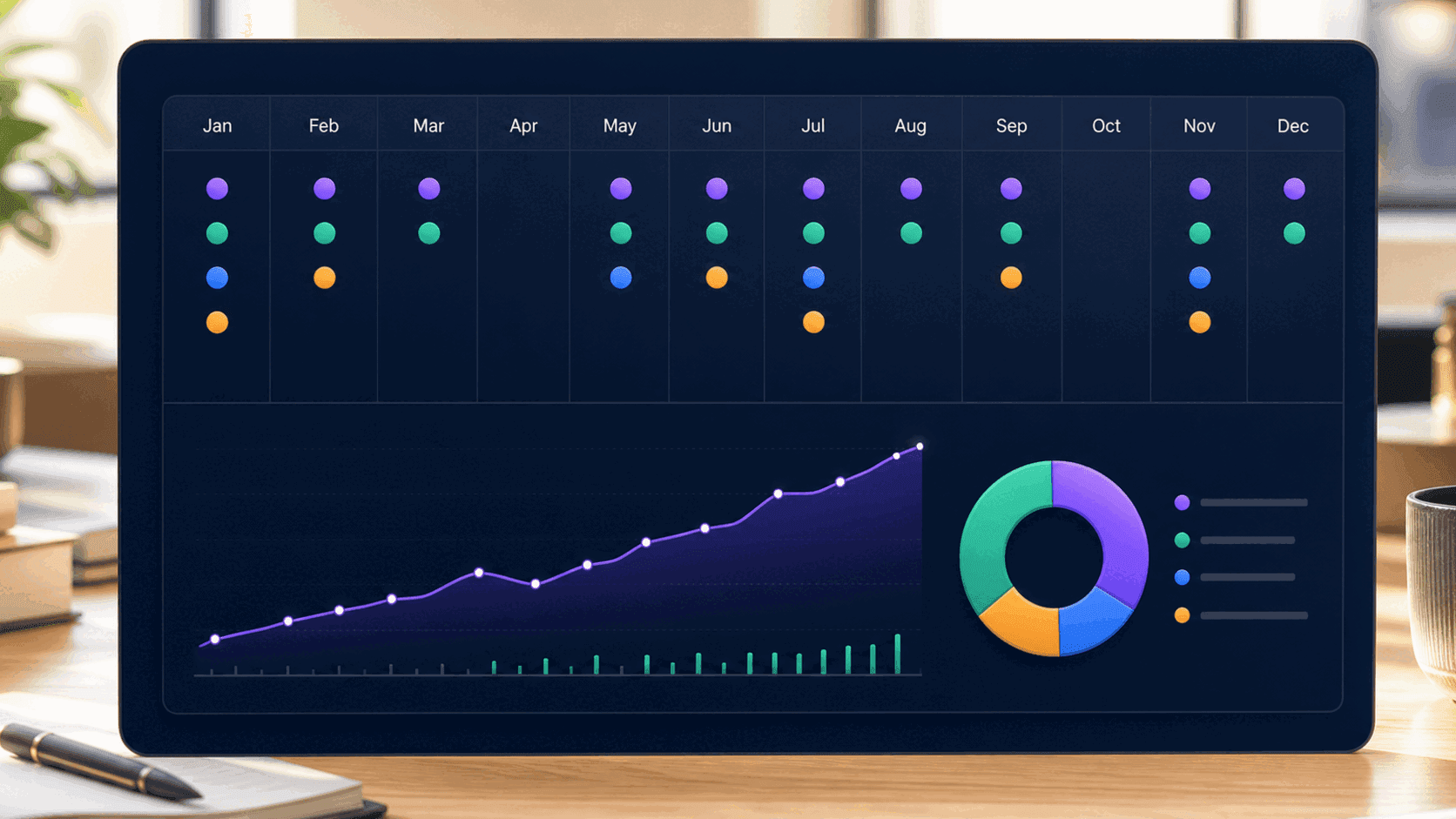
A dividend portfolio can pay exactly the same amount over a year and still feel completely different month to month. Put $90,000 into holdings yielding 3.6% and you collect $3,240 a year either way. If every holding pays on the March–June–September–December cycle, that money arrives as four lumps of $810 and eight empty months. Spread the same money across three quarterly cycles and it arrives as $270 every single month.
Nothing about the yield changed. Only the calendar did. That is why a dividend calendar is the first thing worth building once you hold more than a couple of dividend payers — it shows when cash actually lands, and it shows the one date that decides whether you get paid at all: the ex-dividend date.
This guide covers both: how the four dividend dates work since the US moved to next-day settlement, how to read and fill a dividend calendar, and why "buy before the ex-date and sell after" does not make money.
The four datesDeclaration, ex-dividend, record and payment
Every dividend comes with a short timeline set by the company's board.
- Declaration date — the board announces the amount per share and the dates below.
- Ex-dividend date — the cut-off. Buy on or after this date and the upcoming dividend goes to the seller, not to you.
- Record date — the day the company checks its shareholder list to decide who gets paid.
- Payment date — when the cash actually reaches your brokerage account, often two to four weeks after the ex-date.
Since US stock trades moved to T+1 settlement on May 28, 2024, a purchase settles one business day after the trade. For ordinary cash dividends that put the ex-dividend date and the record date on the same business day. Under the old T+2 cycle the ex-date came one business day before the record date, which is why older guides still describe a gap that no longer exists.
Selling works the same way in reverse: you can sell on the ex-date itself and still receive the dividend, because you owned the shares going into it.
Lumpy vs smoothWhat the same $3,240 looks like on the calendar
Most US companies and ETFs that pay quarterly fall into one of three cycles. Real examples from 2026 filings and fund schedules: Cisco pays in January, April, July and October; Procter & Gamble in February, May, August and November; the Schwab U.S. Dividend Equity ETF (SCHD) in March, June, September and December. A smaller group — funds such as JEPI and a handful of REITs — pays every month.
Here is one $90,000 portfolio at a 3.6% yield, arranged four different ways:
All on Mar/Jun/Sep/Dec
- Empty months
- 8
- Smallest – largest month
- $0 – $810
- Monthly average
- $270
Half Mar cycle, half Feb cycle
- Empty months
- 4
- Smallest – largest month
- $0 – $405
- Monthly average
- $270
Half Mar cycle, half monthly payers
- Empty months
- 0
- Smallest – largest month
- $135 – $540
- Monthly average
- $270
One third in each quarterly cycle
- Empty months
- 0
- Smallest – largest month
- $270 – $270
- Monthly average
- $270
| How the holdings pay | Empty months | Smallest – largest month | Monthly average |
|---|---|---|---|
| All on Mar/Jun/Sep/Dec | 8 | $0 – $810 | $270 |
| Half Mar cycle, half Feb cycle | 4 | $0 – $405 | $270 |
| Half Mar cycle, half monthly payers | 0 | $135 – $540 | $270 |
| One third in each quarterly cycle | 0 | $270 – $270 | $270 |
Source: CalculatorAI · calculatorai.app · CalculatorAI arithmetic; dividends held flat for the year
The monthly average is identical in every row. What changes is how much cash you need to hold in reserve if you spend the income. If you live on $270 a month from a portfolio that pays only in March, June, September and December, you are short $810 by the end of February before the first payment arrives — a full quarter's income has to sit in savings just to make the lumpy version behave like a paycheck.
You reinvest everything
If every dividend goes straight back into shares, timing barely matters. Reinvesting monthly instead of quarterly on $90,000 at 3.6% for 20 years ends about $395 higher — 0.2% of a $184,000 result.
You spend the income
If the dividends pay rent, bills or a retirement budget, eight empty months mean holding a cash buffer or selling shares at the wrong time. Filling the calendar removes that buffer requirement.
If you are building the income from scratch, how to build dividend income covers the yield, growth and reinvestment side; this article is only about timing.
Build the calendarFour steps that take one evening
List every holding that pays
Ticker, number of shares, dividend per share and frequency. Include funds held in retirement accounts — they pay on their own calendar even when you cannot spend the cash.
Add the last ex-date and pay date
Take them from the company's investor-relations page, its dividend press release or the fund sponsor's distribution schedule. The pay month is usually the same every year; the exact day can move by a few days.
Multiply out each month
Shares × dividend per share, placed in the pay month. Add the months up and look for the gaps — those are the months your income is zero.
Set a reminder two days before each ex-date
That is the only date with a deadline. If you plan to add shares, the purchase must settle into the record date, which since T+1 means trading no later than the day before the ex-date.
The Dividend Tracker does steps 2 to 4 for you. Type a ticker and it fills in the dividend per share, the frequency and the last ex-date from the market data feed; its Calendar tab lays out every expected payment for the next twelve months, marks the months that bring in nothing and suggests which quarterly cycle would fill them. It also sends a reminder when an ex-date is two days away and another on the pay date, so you can log the payment while the deposit is on screen. Payments you log are shared with the Portfolio Tracker, so one entry shows up in both places.
Monthly payersWhen a fund that pays every month helps
Monthly payers are the easy way to flatten a calendar, and the two best-known examples sit on opposite ends of the income spectrum. JEPI vs JEPQ explains how the high monthly distributions of those two funds are built from option premium rather than ordinary dividends — which affects how they are taxed and how they behave in a rally. SCHD dividend income, by contrast, is a quarterly payer whose appeal is dividend growth, not monthly smoothness.
The trade-off is worth stating plainly: a monthly payer smooths the calendar, but it does not raise the yield of the portfolio as a whole. In the table above, swapping half the portfolio into monthly payers took the worst month from $0 to $135 — at exactly the same $3,240 a year.
The ex-date trapWhy dividend capture does not pay
The ex-dividend date invites an obvious idea: buy the day before, collect the dividend, sell the day after. It fails for a mechanical reason — on the ex-date the share price opens lower by roughly the amount of the dividend, because the buyer that morning is no longer entitled to it.
You collect $70 and the shares lose about $70
You buy 166.67 shares the day before the ex-date. The next morning the price opens about $0.42 lower, so your shares are worth roughly $70 less — and you are owed a $70 dividend. Before tax you are about even. After tax you are behind: held for only a few days, the dividend does not qualify for the lower qualified rate and is taxed as ordinary income. At a 22% bracket that is $15.40 of tax on $70, plus the bid–ask spread on the round trip.
To be taxed at the lower qualified-dividend rate, a common stock generally has to be held more than 60 days during the 121-day period that starts 60 days before the ex-dividend date. A capture trade never meets that test. The same holding-period logic shows up again when you sell: the rules in how to calculate capital gains tax decide what the sale itself costs.
The ex-date matters for a different reason: timing a purchase you were going to make anyway. If you plan to add shares this week and the ex-date is Thursday, buying by Wednesday's close puts the next dividend in your account. That is a convenience, not a strategy — the price adjusts either way.
ChecklistBefore you add a holding to fill a gap
Would you buy it for its own sake?
Quality, valuation and how it fits the rest of the portfolio come first. The pay month is the last question, not the first.
Check overlap, not just the calendar
Two dividend ETFs on different cycles can hold many of the same companies. A smoother calendar built from duplicate holdings is concentration in disguise.
Check the account it will sit in
Dividends inside an IRA or 401(k) cannot be spent before retirement without consequences. Only taxable-account income smooths a spending budget today.
Look at the payment history, not one payment
A company that cut its dividend once may do it again. Five to ten years of payments say more than the current yield.
Write down the ex-date and pay date
Then let a reminder, not your memory, tell you when the cut-off is.
Tracking the calendar is part of tracking the whole portfolio; how to track your investment portfolio covers the rest — cost basis, allocation and total return.
Where these numbers come from
- Portfolio: $90,000 at a 3.6% blended yield, or $3,240 a year. Dividends are held flat for one year; real dividends change, usually upward for growing companies.
- Cycles: quarterly payers grouped by pay month (Jan/Apr/Jul/Oct, Feb/May/Aug/Nov, Mar/Jun/Sep/Dec). Each quarterly payment is a quarter of that holding's annual dividend; monthly payers pay a twelfth. Real payments vary slightly from quarter to quarter.
- Pay months of named holdings come from the companies' and fund sponsors' published 2026 dividend schedules (Cisco: January, April, July, October; Procter & Gamble: February, May, August, November; SCHD: March, June, September, December). Schedules can change — check the issuer before relying on a month.
- Reserve needed: spending $270 a month from January 1 with income arriving only in March, June, September and December leaves the account $810 short before the first payment.
- Reinvestment comparison: $90,000 compounding at 3.6% for 20 years, monthly vs quarterly. No price growth, taxes or dividend growth, which makes both results conservative; the gap between them is what matters.
- Capture example: an illustrative $60 stock with a $0.42 quarterly dividend. The ex-date drop is approximately the dividend amount on average, not exactly on any given day, because prices move for other reasons too. Tax at 22% assumes the dividend is non-qualified because of the short holding period; state tax is ignored.
- Settlement: T+1 since May 28, 2024; for ordinary cash dividends the ex-dividend date is the same business day as the record date.
FAQFrequently asked questions
What is a dividend calendar?
A month-by-month schedule of when each of your holdings pays its dividend and how much. It shows which months bring in income, which bring in nothing, and the ex-dividend date you must beat to receive each payment.
When do I have to buy a stock to get the dividend?
By the close of the trading day before the ex-dividend date. Since T+1 settlement started on May 28, 2024, the ex-dividend date and the record date are usually the same day, so buying on the ex-date itself is too late.
Can I sell on the ex-dividend date and still get the dividend?
Yes. If you owned the shares at the close of the day before the ex-date, the dividend is yours even if you sell on the ex-date.
How do I get monthly dividend income from quarterly payers?
Hold payers from all three quarterly cycles — January/April/July/October, February/May/August/November and March/June/September/December — in roughly equal income amounts. Together they pay every month. Monthly-paying funds are the other way to fill gaps.
Does dividend capture work?
Not reliably. The share price typically falls by about the dividend on the ex-date, and a dividend held for only a few days is taxed as ordinary income, so the strategy usually loses money after tax and trading costs.
What is the difference between the ex-dividend date and the payment date?
The ex-dividend date decides who gets paid; the payment date is when the cash arrives, often two to four weeks later. You can sell between the two and still receive the payment.
Do monthly dividends pay more than quarterly dividends?
No. Frequency changes the timing, not the total. A fund paying $1 a month and a stock paying $3 a quarter both pay $12 a year per share.
Fill the gaps you can see
A dividend calendar turns a yield into a schedule you can plan around. Build one from your actual holdings, note the ex-date that decides each payment, and fill an empty month only with a holding you wanted anyway.
Add your holdings to the free Dividend Tracker to see the twelve-month calendar and the empty months, and use the DRIP calculator to see what reinvesting those payments adds up to over time.