A candle tells you where price went. It does not tell you who pushed it there, whether they were buying into a wall of resting offers or into thin air, or where the leveraged crowd will be forced out next. That second layer — the trades and the orders behind the bar — is order flow, and for years it lived in expensive desktop terminals built for futures pits. In crypto it has become a small, competitive category of its own: web-first tools that pull every trade and every order-book change from an exchange and draw them as footprints, heatmaps and delta lines.
This guide compares three of them — Quantix Analytics, ATAS and TRDR — on what they actually show, what they cover, what they cost per year and who each one is for. They are not three versions of the same product. One is a young, crypto-only web terminal; one is a fifteen-year-old desktop platform that also does futures and stocks; one is a multi-exchange data desk built around alerts. The right choice depends less on the feature list than on which market you trade and how you review your own trades afterwards.
What order flow showsFour views of the same minute
Every platform in this category draws some subset of the same four things, so it is worth knowing what each one is before comparing who draws it better.
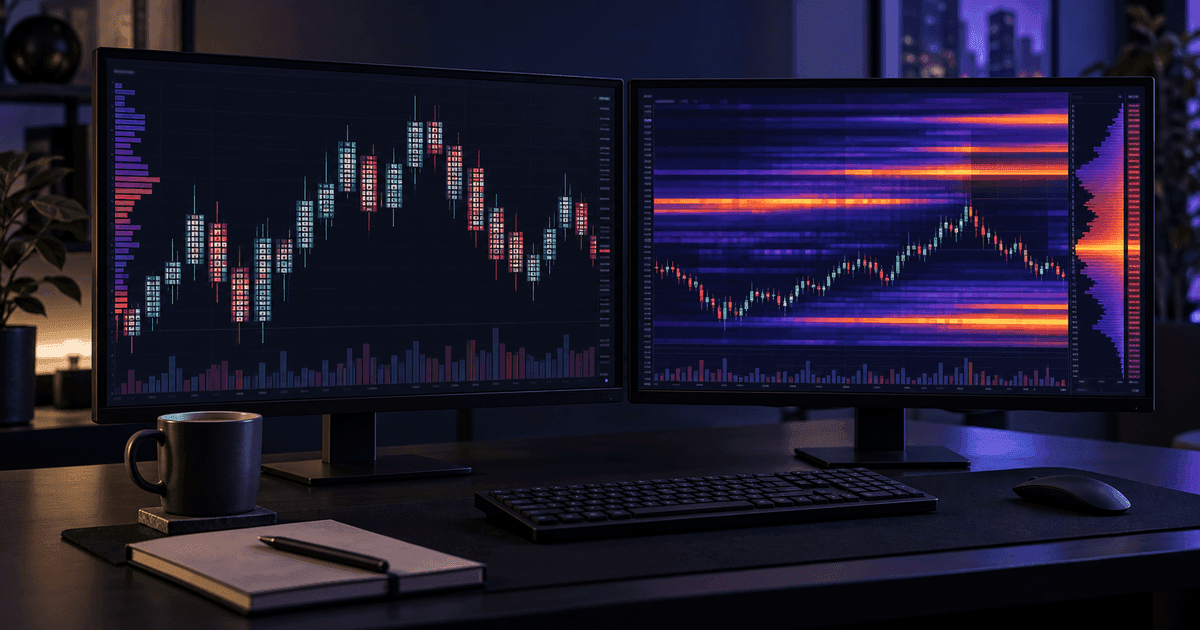
- Footprint (cluster) chart. Each candle is split into price levels, and each level shows how much was bought at the ask and sold at the bid. It answers "was that move driven by aggressive buyers, or did sellers simply step away?" — the question a plain candle cannot.
- Cumulative volume delta (CVD). A running total of aggressive buying minus aggressive selling. Price making a new high while CVD does not is the classic divergence most order-flow strategies are built on.
- DOM and liquidity heatmap. The order book over time: where large resting bids and offers sit, how long they stay, and when they are pulled. A heatmap is the same book painted across the chart, so you can see the walls price bounced from — and the ones that vanished the moment price approached.
- Derivatives context. Open interest, funding, and where leveraged positions are likely to be liquidated. This layer barely exists in futures terminals and is the part crypto platforms tend to do best, because the exchanges publish the data.
The footprint-to-journal workflow we described for TradingView applies here unchanged: the platform shows you the market, and your review shows you whether you actually traded what it showed.
The three platformsDifferent shapes, not different tiers
A crypto-only web terminal, one exchange live today
Web app, no install. Footprint, CVD, DOM heatmap, volume profile, liquidation bubbles and heatmap, basis and account sentiment, an anomaly screener, custom JavaScript indicators and a wallet tracker. Live on Binance spot; Coinbase, Bybit, OKX, Kraken, Deribit and Hyperliquid listed as coming. A built-in academy with strategy lessons. $35–$110 a month; 30-day PRO trial, no card.
The desktop heavyweight that also does futures and stocks
Windows and macOS desktop (a browser beta exists). Footprint with 400+ cluster variations, Smart DOM, Smart Tape, 240+ indicators, market replay, a built-in journal. 25+ connections: CME/EUREX/ICE futures, NYSE/NASDAQ stocks, Binance, Bybit, OKX, Bitget. A free START tier with real-time crypto; €24.95–€89.95 a month, lifetime licences from €999.
TRDR sits between them and is the easiest to misjudge from a screenshot. It is a web platform on TradingView charts whose strength is aggregation: order-book depth, open interest, funding and liquidations from Binance, Coinbase, Kraken, Bybit, OKX and others combined into one view, plus a screener and an alert engine that can fire to Telegram, e-mail, webhook, a browser sound or text-to-speech on any combination of those metrics. Its documentation does not describe a footprint chart or a market-replay mode; it is a data desk and a watch-tower rather than an execution-context tool. €29.95–€59.95 a month.
Coverage and deliveryWhere each one is strong and where it is thin
Runs as
- Quantix
- Web app
- ATAS
- Desktop (Win/Mac), web beta
- TRDR
- Web app
Markets
- Quantix
- Crypto spot
- ATAS
- Futures, stocks, crypto
- TRDR
- Crypto
Exchanges live
- Quantix
- Binance (6 more listed)
- ATAS
- 25+ connections
- TRDR
- Binance, Coinbase, Kraken, Bybit, OKX, others
Footprint chart
- Quantix
- Yes
- ATAS
- Yes, 400+ variants
- TRDR
- Not documented
DOM / liquidity heatmap
- Quantix
- Yes
- ATAS
- Smart DOM + heatmap
- TRDR
- Aggregated book depth overlay
CVD / delta
- Quantix
- Yes
- ATAS
- Yes
- TRDR
- Yes
Liquidations, OI, funding
- Quantix
- Bubbles + heatmap, basis, sentiment
- ATAS
- Crypto connections
- TRDR
- Yes, aggregated
Alerts
- Quantix
- Not documented
- ATAS
- Yes
- TRDR
- Telegram, e-mail, webhook, sound, TTS
Market replay
- Quantix
- Not documented
- ATAS
- Yes (paid tiers)
- TRDR
- Not documented
Custom indicators
- Quantix
- JavaScript
- ATAS
- C# / built-in editor
- TRDR
- Templates
Built-in journal
- Quantix
- No
- ATAS
- Yes (paid tiers)
- TRDR
- No
Learning material
- Quantix
- Academy lessons in-app
- ATAS
- Extensive docs, courses
- TRDR
- Docs + videos
| Quantix | ATAS | TRDR | |
|---|---|---|---|
| Runs as | Web app | Desktop (Win/Mac), web beta | Web app |
| Markets | Crypto spot | Futures, stocks, crypto | Crypto |
| Exchanges live | Binance (6 more listed) | 25+ connections | Binance, Coinbase, Kraken, Bybit, OKX, others |
| Footprint chart | Yes | Yes, 400+ variants | Not documented |
| DOM / liquidity heatmap | Yes | Smart DOM + heatmap | Aggregated book depth overlay |
| CVD / delta | Yes | Yes | Yes |
| Liquidations, OI, funding | Bubbles + heatmap, basis, sentiment | Crypto connections | Yes, aggregated |
| Alerts | Not documented | Yes | Telegram, e-mail, webhook, sound, TTS |
| Market replay | Not documented | Yes (paid tiers) | Not documented |
| Custom indicators | JavaScript | C# / built-in editor | Templates |
| Built-in journal | No | Yes (paid tiers) | No |
| Learning material | Academy lessons in-app | Extensive docs, courses | Docs + videos |
Source: CalculatorAI · calculatorai.app · quantix-analytics.com, atas.net, trdr.io and docs.trdr.io, read 2026-09-20
Three things in that table decide most choices:
- 01If you trade CME futures, the choice is made. Only ATAS connects to them, and its footprint and DOM are the category's reference implementation. A crypto trader who never touches ES or NQ is paying for that breadth without using it.
- 02If you trade several crypto exchanges and care about the combined book, TRDR's aggregation is the feature the other two do not have. Its trade-off is the missing footprint: you see where liquidity sits across venues, not the bid/ask split inside each candle.
- 03If you trade Binance spot from a browser and want footprint plus the derivatives layer in one screen, Quantix is the most direct fit — with the caveat, stated plainly on its own site, that the other exchanges are still listed rather than live. That is the honest picture of a young product: complete on the one venue it covers, not yet wide.
What a year costsList prices, paid monthly and paid annually
Quantix Lite
- Per month
- $35
- Paid monthly, per year
- $420
- Annual plan
- —
- What the tier adds
- Top-50 symbols, core order flow
Quantix PRO Analyst
- Per month
- $60
- Paid monthly, per year
- $720
- Annual plan
- —
- What the tier adds
- All symbols, DOM heatmap, advanced indicators; 30-day trial
Quantix ELITE Trader
- Per month
- $110
- Paid monthly, per year
- $1,320
- Annual plan
- —
- What the tier adds
- Priority support, extended history (listed as coming)
ATAS START
- Per month
- €0
- Paid monthly, per year
- €0
- Annual plan
- €0
- What the tier adds
- Real-time crypto on one connection, delayed futures, 3 indicators
ATAS PLUS
- Per month
- €24.95
- Paid monthly, per year
- €299.40
- Annual plan
- €239.40
- What the tier adds
- 6 assets, real-time crypto, range/Renko frames
ATAS PRO
- Per month
- €69.95
- Paid monthly, per year
- €839.40
- Annual plan
- €479.40
- What the tier adds
- Real-time futures and stocks, 3 connections
ATAS ULTRA
- Per month
- €89.95
- Paid monthly, per year
- €1,079.40
- Annual plan
- €599.40
- What the tier adds
- Unlimited, MBO bundle, options tools
TRDR Pro
- Per month
- €29.95
- Paid monthly, per year
- €359.40
- Annual plan
- €287.40
- What the tier adds
- Core aggregation, alerts
TRDR Premium
- Per month
- €59.95
- Paid monthly, per year
- €719.40
- Annual plan
- €575.40
- What the tier adds
- Full indicator set, more alerts
| Plan | Per month | Paid monthly, per year | Annual plan | What the tier adds |
|---|---|---|---|---|
| Quantix Lite | $35 | $420 | — | Top-50 symbols, core order flow |
| Quantix PRO Analyst | $60 | $720 | — | All symbols, DOM heatmap, advanced indicators; 30-day trial |
| Quantix ELITE Trader | $110 | $1,320 | — | Priority support, extended history (listed as coming) |
| ATAS START | €0 | €0 | €0 | Real-time crypto on one connection, delayed futures, 3 indicators |
| ATAS PLUS | €24.95 | €299.40 | €239.40 | 6 assets, real-time crypto, range/Renko frames |
| ATAS PRO | €69.95 | €839.40 | €479.40 | Real-time futures and stocks, 3 connections |
| ATAS ULTRA | €89.95 | €1,079.40 | €599.40 | Unlimited, MBO bundle, options tools |
| TRDR Pro | €29.95 | €359.40 | €287.40 | Core aggregation, alerts |
| TRDR Premium | €59.95 | €719.40 | €575.40 | Full indicator set, more alerts |
Source: CalculatorAI · calculatorai.app · drafts/crypto-order-flow-platforms-numbers.mjs — prices read 2026-09-20
Two readings of that table. For a crypto-only trader the mid tiers land close together — roughly $60 a month for Quantix PRO, €48–€60 for TRDR Premium, and ATAS PLUS at €20–€25 for a single exchange — so price is not what separates them; coverage and the footprint are. For a trader who wants futures too, ATAS PRO on the annual plan is the only line that includes them, and at €479 a year it is cheaper than a year of Quantix PRO paid monthly, which is a reminder that the cheapest tool is the one whose scope matches yours.
The part no platform shows youYour own trades
Order flow answers "what did the market do?" at a resolution a candle cannot. It has nothing to say about "what did I do?" — whether you took the delta divergence or froze, whether the heatmap wall you faded was the third one that day, whether your winners come from the setups you think they do. That record lives in a journal, and ATAS is the only one of the three that ships one (on paid tiers); Quantix and TRDR leave it to you.
That is not a mark against them. The best trading journal apps are all separate products for a reason: the review is a different job from the chart, and a journal that works across your futures account, your Binance account and your paper trades is more useful than one welded to a single platform. Log the setup you saw in the order flow — "absorption at the heatmap wall, CVD divergence" — as a tag on the trade, and in a month you will know which of the four views above actually pays you — the expectancy per setup is the number that answers it. How to keep a trading journal covers the fields that make that possible.
Frequently asked questions
Is order flow useful on crypto at all, given how fragmented the market is? More than on many futures, in one respect: the exchanges publish liquidations, open interest and funding in real time, which gives crypto order flow a derivatives layer futures traders mostly infer. The fragmentation is the argument for aggregation (TRDR's approach) or for trading the deepest venue and reading it fully (Quantix on Binance, ATAS on any of its crypto connections).
Do I need a footprint chart, or is CVD enough? CVD tells you the net direction of aggression; the footprint tells you where in the candle it happened and whether it was absorbed. Traders who scalp off the book generally want the footprint; swing traders often get what they need from CVD and the heatmap. TRDR's design is a bet that the second group is larger.
Can I trade from these platforms? ATAS connects to brokers and exchanges for execution on its paid tiers. Quantix and TRDR are analysis terminals; you execute on the exchange. For a review workflow that is a distinction without a difference — the journal entry is the same either way.
Which one is best for a beginner? The one with a free tier and material to learn from: ATAS START costs nothing and its documentation is deep; Quantix bundles an academy with the trial. Beginners mostly do not need the ULTRA / ELITE tiers of anything for a year.
Are the prices above the final prices? They are the list prices on the public pricing pages on the date in the sources, before VAT and before any promotion. All three change their tiers from time to time; check the page before you subscribe.
Sources and methodology
Feature and pricing statements are taken from quantix-analytics.com (home, about, indicators documentation and pricing), atas.net (home and pricing) and trdr.io with docs.trdr.io, all read on 2026-09-20; yearly figures are computed in drafts/crypto-order-flow-platforms-numbers.mjs from those list prices. "Not documented" means the platform's public pages did not describe the feature at that date, not that it is absent. This is not a performance review: none of the platforms was tested for data accuracy or latency, and no claim about trading results is made. No payment or affiliate relationship exists with any of the three companies.