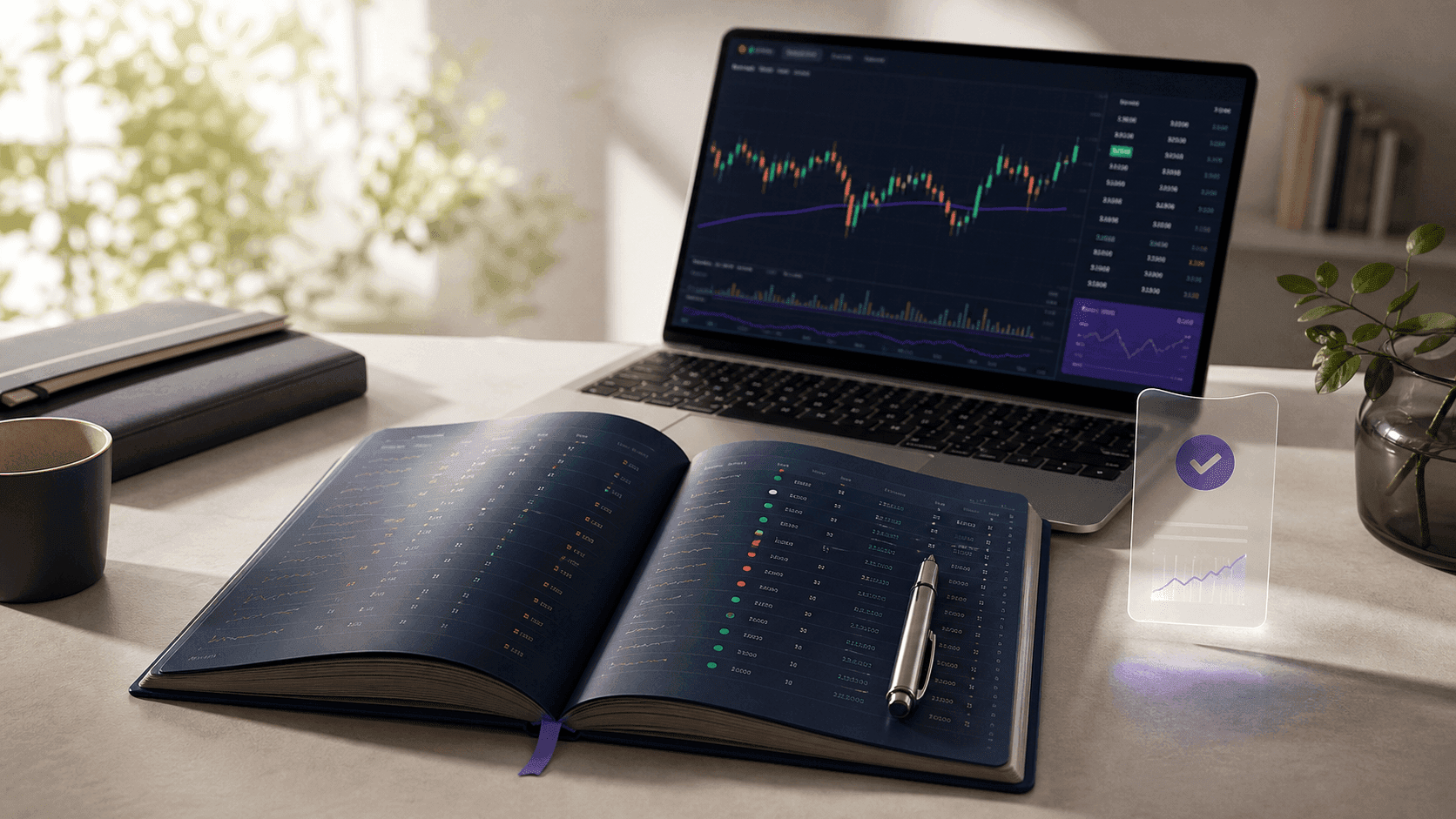
Most traders do not blow up because they lack a strategy. They blow up because they keep making the same three mistakes and never notice the pattern. A trading journal is what turns those invisible patterns into a short, fixable list. It is the single highest-leverage habit in trading, and it costs nothing but ten minutes a day.
This guide covers what to actually log (not everything — just what changes your decisions), the metrics that separate a real journal from a pile of trades, and a review routine that turns entries into edge.
Why a trading journal beats a bigger strategy
You can read a hundred setups and still lose, because execution — not knowledge — is where money leaks. A journal exposes execution. After thirty logged trades you can usually see things like:
- You are profitable on your A+ setups and give it all back on impulse trades.
- Your average loss is bigger than your average win, so a 60% win rate still loses money.
- You overtrade on red days trying to win it back.
- Your best trades share a condition you were not consciously trading.
None of that shows up in your broker statement. It only shows up when every trade has a reason, a plan, and an honest note.
What to log on every trade
Keep it short enough that you will actually do it. The fields that carry their weight:
- Instrument and date — what and when.
- Direction and setup — long or short, and the named setup (breakout, pullback, reversal). Naming forces honesty about whether it was a setup at all.
- Entry, stop and target — the three prices that define the trade before you take it. If you cannot state a stop, you do not have a trade.
- Position size and risk — how much you stood to lose in dollars, not just share count. This is the number that keeps you alive.
- Outcome — exit price and realized profit or loss.
- Emotional state / notes — one line: were you calm, bored, revenge-trading, chasing? This field predicts more losses than any indicator.
Optional but powerful: a screenshot of the chart at entry, and the market context (trend, news, session).
The metrics that actually matter
A list of trades is data; these turn it into feedback:
- Win rate — the percent of trades that made money. Useful only next to the next metric.
- Average win vs. average loss (payoff ratio) — a 40% win rate is very profitable if wins are 3x losses, and fatal if they are equal.
- Expectancy — the average dollars you make per trade across everything. This is the one number that tells you whether the whole system is positive. We break the math down in the guide on win rate, risk-reward and expectancy.
- Max drawdown — the biggest peak-to-trough dip, and how long you spent below the previous high. It tells you what the strategy actually feels like to hold, and what a normal drawdown looks like tells you whether yours is one.
- Performance by setup — the same stats, split by setup name. This is where you find the trades to cut and the ones to size up.
You size up what works and cut what does not — but only once the data, not your memory, tells you which is which.
A review routine that creates edge
Logging without review is a diary, not a tool. Two loops:
- Daily (5 minutes): log the day's trades while they are fresh, tag each as followed plan or broke plan, and write one sentence on the worst trade.
- Weekly (20 minutes): sort by setup and by whether you followed your plan. Ask three questions — What is my most profitable setup? Where did I break my own rules? What single change would have helped most this week? Write the one change down and make it next week's focus.
The magic is not in any single entry. It is that the review turns "I think I overtrade" into "I took 6 impulse trades this week and lost $420 on them," which is a problem you can actually solve.
Common journaling mistakes
- Only logging winners, or only losers. You need both, or the stats lie.
- Logging outcomes but not plans. Without the pre-trade stop and target, you cannot tell good process from lucky results.
- Skipping the emotion field. It feels soft; it is the most predictive field you have.
- Never reviewing. An unread journal changes nothing.
- Waiting for the perfect tool. A notebook beats an unused app — but a purpose-built journal beats a notebook, because it does the math for you.
Do it without the spreadsheet
You can start in a notebook today. When you want the metrics — win rate, payoff, expectancy, drawdown, performance by setup — computed automatically across crypto, forex, stocks, futures and options in one place, use the free Trading Journal. It stores your entries, plans and screenshots, and turns them into the review stats above so you spend your time deciding, not calculating. Pair it with the Risk-Reward Calculator before each trade so the stop, target and position size are set before you click buy.
Frequently asked questions
What should a trading journal include? At minimum: instrument, date, direction, setup name, entry, stop, target, position size, dollar risk, exit and realized profit or loss, plus a one-line note on your state of mind. The plan (stop and target) matters as much as the outcome — it is what lets you separate good process from luck.
How often should I review my trading journal? Log trades daily while they are fresh, and do a deeper review weekly — sort by setup and by whether you followed your plan, then pick one change to focus on next week. Monthly, zoom out to your equity curve and drawdown.
Do I need a journal if I am a beginner trader? Especially then. Beginners make the most fixable mistakes, and the journal is what makes them visible before they compound. It is the cheapest tutor you will ever have.
Can a trading journal really improve my results? It does not add setups; it removes the repeated errors that quietly cost you. For most traders, cutting the worst 10% of impulsive trades does more for the bottom line than any new strategy.
What is the difference between a trading journal and a portfolio tracker? A trading journal is about process and per-trade discipline for active trading. A portfolio tracker is about the current value, allocation and long-term return of what you hold. Active traders often use both.
Start your journal today
Open the free Trading Journal, log your next five trades with a plan and a note, and review them on Sunday. That one habit, kept for a month, will teach you more about your trading than any course.