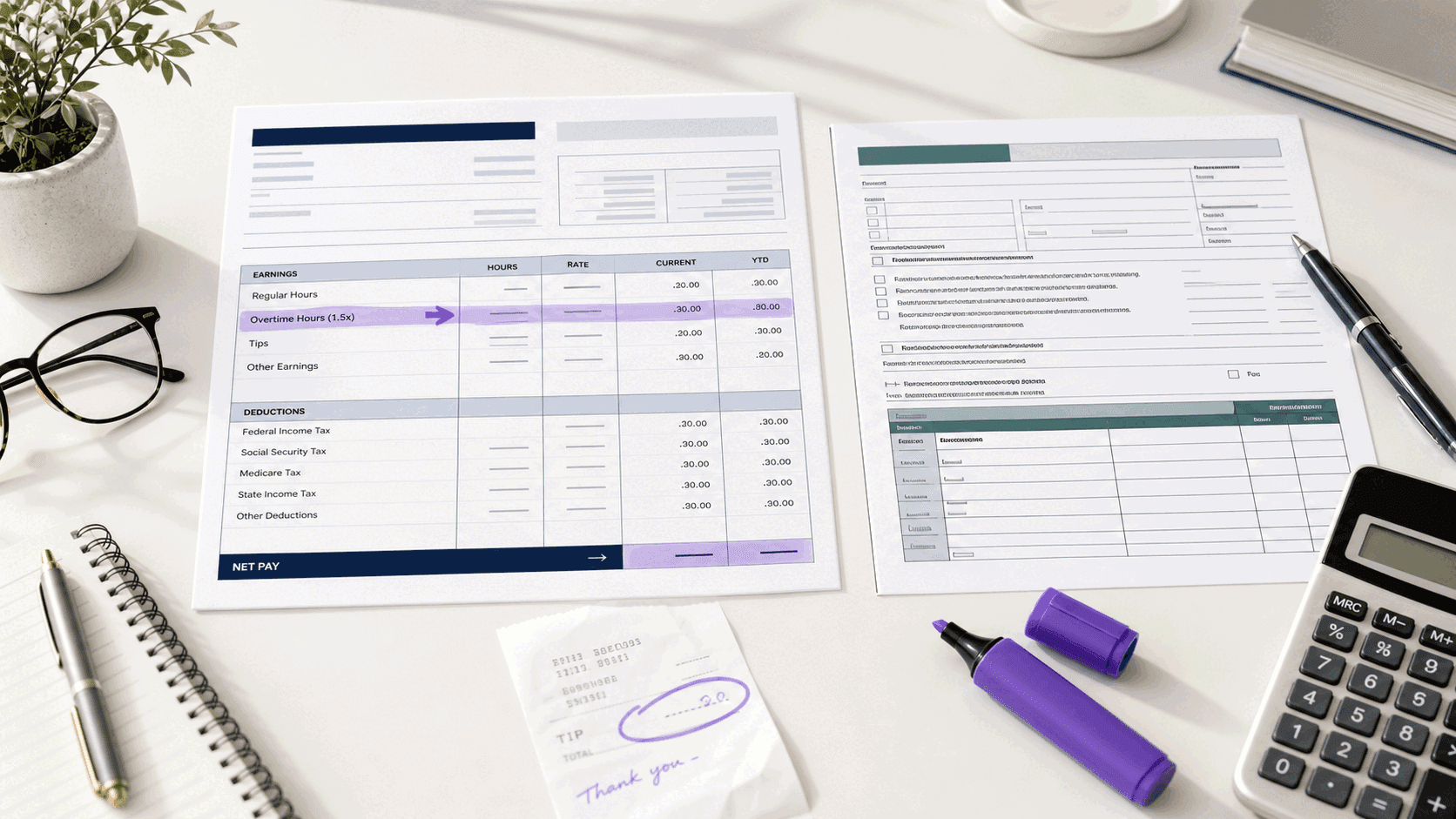
Form W-4 tells your employer how much federal income tax to take out of each paycheck. Get it wrong and you find out in April, with a bill or with a refund that was your money all year. The good news for 2027: the form barely changes, and if nothing in your life changed, you do not need a new one.
As of November 16, 2026, the IRS has posted only a draft of the 2027 Form W-4 (posted July 7, 2026, marked "DRAFT — DO NOT FILE"). Its layout matches the 2026 form, but several dollar amounts are still blank. Below: Steps 1 to 5, what is still missing, how the 2025 law's tips, overtime, car-loan and senior deductions reach your paycheck, and three examples worked with the official 2027 brackets.
Who this is for: W-2 employees in the US. Not for: 1099 contractors and freelancers, who have no employer withholding and pay tax themselves during the year — see quarterly estimated taxes for freelancers. If you have a W-2 job and a side business, example 3 is for you.
The 2027 formWhat changes on the 2027 W-4
We compared the IRS draft 2027 W-4 line by line with the final 2026 form. The five steps, the two-jobs checkbox and the Deductions Worksheet are the same. The differences:
Step 3(a), per child under 17
- 2026 form
- $2,200
- 2027 draft
- Blank; the 2027 credit is $2,300
Worksheet line 11, standard deduction
- 2026 form
- $16,100 / $32,200 / $24,150
- 2027 draft
- Blank; 2027 is $16,600 / $33,200 / $24,925
Worksheet line 6b, state and local tax cap
- 2026 form
- $40,400
- 2027 draft
- $40,804
Step 3, other credits
- 2026 form
- Foreign tax, education
- 2027 draft
- Adds the new federal scholarship tax credit
Multiple Jobs tables, page 5
- 2026 form
- Filled in
- 2027 draft
- Blank until the final form
Deadline to renew exempt status
- 2026 form
- February 16, 2027
- 2027 draft
- February 15, 2028
| Line | 2026 form | 2027 draft |
|---|---|---|
| Step 3(a), per child under 17 | $2,200 | Blank; the 2027 credit is $2,300 |
| Worksheet line 11, standard deduction | $16,100 / $32,200 / $24,150 | Blank; 2027 is $16,600 / $33,200 / $24,925 |
| Worksheet line 6b, state and local tax cap | $40,400 | $40,804 |
| Step 3, other credits | Foreign tax, education | Adds the new federal scholarship tax credit |
| Multiple Jobs tables, page 5 | Filled in | Blank until the final form |
| Deadline to renew exempt status | February 16, 2027 | February 15, 2028 |
Source: CalculatorAI · calculatorai.app · IRS Form W-4 (2026), created 12/8/25; IRS draft Form W-4 (2027), created 6/10/26, posted July 7, 2026; 2027 amounts from IR-2026-133 and Rev. Proc. 2026-35. Read November 16, 2026.
Blanks are normal in an early draft; the 2026 form was finalized on December 8, 2025, so expect the final 2027 version around then. The 2027 amounts themselves are already set: on November 5, 2026 the IRS raised the child tax credit to $2,300 and the standard deduction to $16,600 single, $33,200 married filing jointly and $24,925 head of household (IR-2026-133). The full tables are in our 2027 tax brackets guide.
Step by stepHow to fill out each step
The form says it plainly: complete Steps 2–4 only if they apply to you. A single person with one job and no dependents fills in Step 1, signs Step 5 and is done.
Step 1 — personal information and filing status
Name, address, Social Security number and the filing status you expect on your 2027 return. It decides which standard deduction and brackets payroll uses. Head of household is only for unmarried people who pay more than half the cost of a home for themselves and a qualifying person.
Step 2 — multiple jobs or a working spouse
For two or more jobs at once, or a joint return where both spouses work. Pick ONE option: (a) the IRS Tax Withholding Estimator, the most accurate and the one to use with self-employment income; (b) the Multiple Jobs Worksheet, with the result in Step 4(c); or (c) a checkbox, when there are exactly two jobs in total, ticked on both W-4s.
Step 3 — dependents and other credits
If income will be $200,000 or less ($400,000 joint): children under 17 times the child credit, plus $500 per other dependent, plus other credits you expect. With two jobs, fill it in on one W-4 only, ideally the highest-paying job.
Step 4 — other adjustments
4(a): interest, dividends or retirement income with no withholding of its own (not self-employment income). 4(b): the total from the Deductions Worksheet on page 4; leave it blank and payroll assumes the standard deduction. 4(c): a flat extra dollar amount taken from every paycheck.
Step 5 — sign and date
An unsigned W-4 is not valid. Without a valid one, Publication 15 tells your employer to withhold as if you were single with no other entries.
New deductionsTips, overtime, car-loan interest, seniors
The 2025 tax law (P.L. 119-21, the "One Big Beautiful Bill Act") created four deductions for 2025 through 2028. The IRS put all of them on the 2026 W-4's Deductions Worksheet, and the 2027 draft keeps them unchanged:
- Line 1a, qualified tips — up to $25,000, if total income is under $150,000 ($300,000 joint).
- Line 1b, qualified overtime — only the "and-a-half" part of time-and-a-half, up to $12,500 ($25,000 joint), same income limits.
- Line 1c, car-loan interest — up to $10,000, if income is under $100,000 ($200,000 joint). Which cars and loans qualify: car loan interest deduction.
- Lines 3a/3b, age 65 or older — $6,000 per person, if income is under $75,000 ($150,000 joint).
- Line 12, cash gifts to charity — up to $1,000 ($2,000 joint) for people who take the standard deduction, new from 2026.
The total goes in Step 4(b). The draft 2027 Publication 15-T (November 9, 2026), the employer's withholding manual, tells employers to apply an updated W-4 so that employees "receive more money in each paycheck instead of waiting until filing their income tax return." Without the W-4 entry, the whole benefit arrives as a refund when you file.
The W-4 does not stop Social Security and Medicare on tips and overtime. And the worksheet's income limits are simple cut-offs, while on the return the deductions phase out gradually. What counts as qualified, and how the phase-out works, is in no tax on tips and overtime.
Life eventsWhen to file a new W-4
The form's rule: file a new one when your situation changes the entries on it. In practice:
New job
Start from your current situation, not a copy of your old form. If you start mid-year, use the estimator: it accounts for what was already withheld.
Marriage or divorce
Filing status changes in Step 1. If both spouses work, Step 2 almost always applies; two W-4s each assuming the full joint standard deduction is the classic way to owe at tax time.
A second job, or your spouse starts working
Each employer withholds as if it were your only job. Step 2 fixes that — see example 2.
A baby or new dependent
Add the child in Step 3 on one W-4. At $2,300 per child for 2027, withholding drops by about $88 per biweekly paycheck.
A side business or 1099 income
Nobody withholds on it. Cover it with Step 4(c) or with quarterly estimated payments — see example 3.
A big bonus
Usually no W-4 change. Bonuses are often withheld at a flat 22%, or 37% on the part above $1 million in a year (Publication 15), whatever your W-4 says. That is withholding, not the final tax.
If your top bracket is 12%, the flat 22% over-withholds a $5,000 bonus by about $500 ($1,100 withheld against roughly $600 of tax), and it comes back as a refund. In the 24% bracket or higher, 22% is slightly too little. The Bonus Tax Calculator shows both methods your employer may use.
The estimatorUsing the IRS Tax Withholding Estimator
The Tax Withholding Estimator asks about your income, withholding so far and deductions, then produces a pre-filled W-4. It takes about 25 minutes, asks for no name or Social Security number, and does not save your answers. Have your latest pay stubs ready, and your spouse's if you file jointly.
The W-4 recommends the estimator when you start mid-year, have bonuses or business income, or hold more than one job, and says to run it again at the beginning of each year. For a 2027 W-4, that means January, with your first 2027 pay stub in hand.
Worked examplesThree W-4s, worked through
All three use the 2027 brackets and standard deductions from Rev. Proc. 2026-35, federal income tax only, and 26 biweekly paychecks.
Single, one hourly job, regular overtime
Maya earns $28 an hour for 2,080 hours, plus about 5 overtime hours a week for 50 weeks at $42: $68,740 of pay. Qualified overtime is only the extra $14 an hour: 250 × $14 = $3,500. Her W-4: Step 1 single, Steps 2 and 3 blank, Deductions Worksheet line 1b $3,500 carried to Step 4(b), then sign. Without the 4(b) entry, the same $431.50 arrives as a refund in 2028.
Married, two jobs, one child
Sam earns $85,000 and Jordan $55,000, filing jointly with a 6-year-old. Their 2027 tax is $12,579, or $10,279 after the $2,300 child credit. If both skip Step 2, each employer gives its job the full $33,200 joint standard deduction and the low brackets, so together they withhold about $7,884 before the credit: $4,695 short, about $181 a paycheck. With the Step 2(c) box ticked on both forms, each job gets half the deduction and half the brackets, and about $1,363 too much is withheld. Jordan earns more than half of Sam's pay, the case where the form says the checkbox is generally the more accurate option. The child goes in Step 3 on Sam's W-4 only.
The Multiple Jobs Worksheet is coarser here. The 2027 tables are still blank, but the 2026 cell for an $80,000–$99,999 job and a $50,000–$59,999 job reads $6,610 a year ($254 a paycheck in Step 4(c)). One value covers a whole band of incomes, so for this couple it lands about $1,900 above their actual tax. The estimator gives the exact figure.
Single, W-2 job plus a side gig
Alex earns $70,000 at a job and expects $12,000 of net profit from freelance design. The gig adds self-employment tax of about $1,696 (15.3% of 92.35% of profit) and about $1,963 of income tax, after deducting half the self-employment tax and the 20% qualified business income deduction. Total extra: about $3,658, or $141 per paycheck in Step 4(c) of the job's W-4, instead of four quarterly payments.
Why withholding instead of estimated payments? IRS Publication 505 treats tax withheld from wages as paid evenly through the year, whenever it was actually withheld; estimated payments count on their due dates. So raising Step 4(c) in October can still cover an April shortfall, and a late quarterly payment cannot.
Where these numbers come from
- Forms: IRS Form W-4 (2026, created December 8, 2025) and the draft Form W-4 (2027, created June 10, 2026, posted July 7, 2026), both read in full on November 16, 2026. No final 2027 form had been released.
- 2027 amounts: Rev. Proc. 2026-35 and IR-2026-133 (November 5, 2026).
- Withholding rules: Publication 15 (2026) for effective dates, the no-W-4 default, the exempt deadline and the 22%/37% bonus rates; draft Publication 15-T (2027, November 9, 2026) for tips and overtime; Publication 505 for withholding counting as paid evenly.
- Our arithmetic: federal income tax only, no state tax, no pre-tax benefits. "Withholding without Step 2" is modeled as tax on each job's pay alone with the full joint standard deduction. Payroll's Publication 15-T tables give similar but not identical results, so treat the shortfall as an approximation. Example 3 ignores the 0.9% Additional Medicare Tax, which starts well above this income. The 2026 Multiple Jobs cell is shown only because the 2027 one is blank.
FAQFrequently asked questions
Do I need to fill out a new W-4 for 2027?
No, unless something changed or you claimed exempt for 2026. Your current W-4 stays in effect, and employers switch to the 2027 withholding tables on their own. If you claimed exempt for 2026, file a new form by February 16, 2027.
Should I claim 0 on my W-4?
Allowances, where "0" or "1" meant something, were removed in 2020. To have more withheld, enter a dollar amount in Step 4(c). To have less withheld, use Steps 3 and 4(b).
Can I get the tips or overtime deduction in my paycheck instead of a refund?
Yes. Put your expected qualified tips or overtime premium on line 1a or 1b of the Deductions Worksheet and carry the total to Step 4(b). Social Security and Medicare are still withheld.
Is a big refund a sign I filled out the W-4 right?
It means you over-withheld and lent the government money interest-free. Some people like that as forced savings. If you would rather have the money now, lower your withholding with the estimator; aim to owe less than $1,000, the usual point where an underpayment penalty can start.
How often can I change my W-4?
As often as you like. Your employer must apply it no later than the first payroll period ending on or after the 30th day after receiving it. Only future paychecks change.
Next stepCheck one paycheck before January
Take your last pay stub and note the federal withholding. Then put your 2027 pay into the Paycheck Calculator and compare its federal line with what your employer takes. If they are close and nothing in your life changed, leave the W-4 alone. If not — or you married, had a child, took a second job or started earning steady overtime — run the IRS estimator in January and file a new W-4 with the numbers it gives you.
This is a plain-English guide to a federal form, not tax advice. State withholding uses separate state forms, and a payroll department or tax preparer can confirm your own case.