Every landlord eventually stands on the driveway with a contractor's quote and the same question: can I deduct this now, or do I have to spread it over 27.5 years? The answer decides whether an $18,000 roof cuts this year's tax bill by about $4,300 or by about $110.
The IRS draws the line in a set of rules called the tangible property regulations. They are longer than most landlords ever read, but the working parts fit on a page: one test with three questions, three safe harbors that let you deduct more than the test alone would allow, and one election that most people have never heard of and that is worth thousands on a replaced roof.
This guide is for U.S. individual landlords with long-term residential rentals reporting on Schedule E. It does not cover short-term rentals run like a hotel, commercial buildings (39-year property), or people who buy and renovate houses to sell them — flippers are dealers, and their renovation costs are inventory, not repairs. It continues the same $350,000 house we used in our rental property depreciation guide.
The testRepair or improvement: the three questions
A cost is an improvement — capitalized and depreciated — if it does any one of three things to the property. Everything else that keeps the property running is a repair, deducted in full in the year you pay it.
Betterment
It fixes a defect that existed before you bought the property, adds something physical, or materially increases capacity, strength or quality. Adding a bathroom, upgrading to much better windows, or fixing the foundation crack the inspection report flagged.
Restoration
It replaces a major component or a substantial structural part, rebuilds something to like-new condition after it fell apart, or follows a casualty loss you deducted. Replacing the whole roof, the furnace or all of the plumbing.
Adaptation
It converts the property to a new or different use. Turning a garage into a rentable studio, or a single-family house into two units.
The step that decides most cases is what you measure against. The IRS does not compare a repair to the whole house; it compares it to the part of the house it touches. A building is split into the structure plus eight building systems — plumbing, electrical, HVAC, elevators, escalators, fire protection and alarms, security, and gas distribution. A new furnace is small next to a $350,000 house, but it is a major component of the HVAC system, so it is a restoration. Replacing one cracked pipe fitting is a repair; replacing all the supply lines in the house is not.
The examplesCommon jobs, sorted
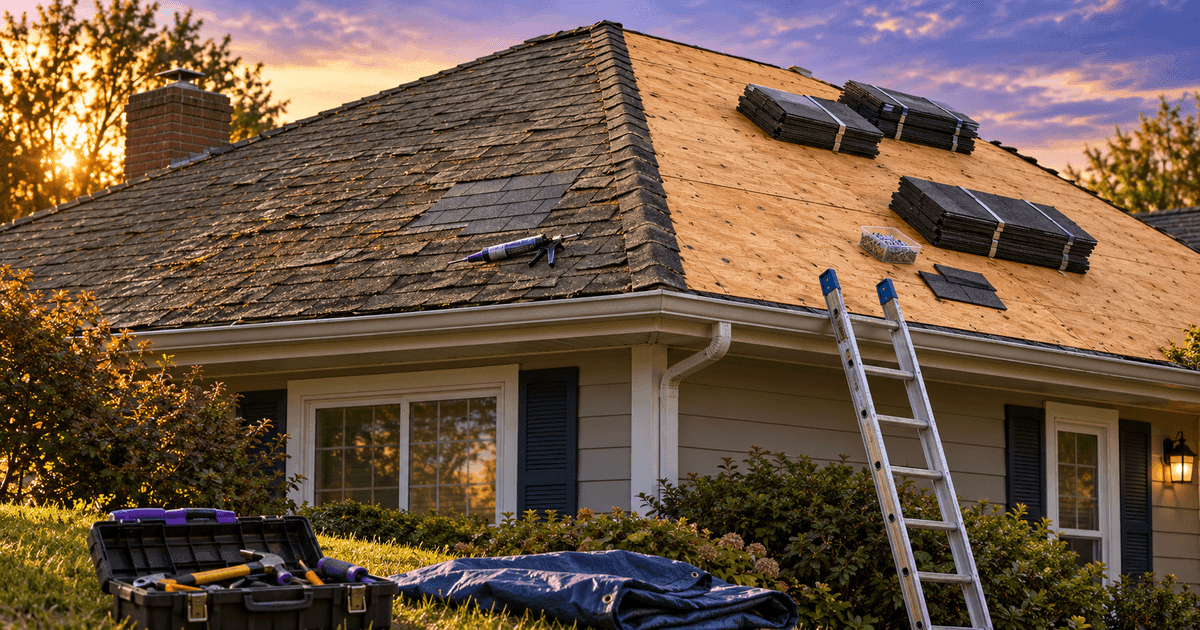
Patch a roof leak, replace storm-damaged shingles on one slope
- Usual treatment
- Repair
- Why
- Returns the roof to working order; no major component replaced
Repaint between tenants
- Usual treatment
- Repair
- Why
- Keeps the property in its existing condition
Service the furnace, replace a thermostat
- Usual treatment
- Repair
- Why
- Routine upkeep of the HVAC system
Replace one broken window pane
- Usual treatment
- Repair
- Why
- Small part of the structure, like-for-like
Replace the entire roof
- Usual treatment
- Improvement
- Why
- Restoration: a major component of the structure
Replace the furnace or the water heater for the whole house
- Usual treatment
- Improvement
- Why
- Restoration: a major component of a building system
Replace every window with upgraded units
- Usual treatment
- Improvement
- Why
- Restoration of a substantial structural part; often also a betterment
Fix defects the inspection found before the first tenant
- Usual treatment
- Improvement
- Why
- Betterment: the condition existed before you bought the house
Convert the garage into a studio
- Usual treatment
- Improvement
- Why
- Adaptation to a new use
| Job | Usual treatment | Why |
|---|---|---|
| Patch a roof leak, replace storm-damaged shingles on one slope | Repair | Returns the roof to working order; no major component replaced |
| Repaint between tenants | Repair | Keeps the property in its existing condition |
| Service the furnace, replace a thermostat | Repair | Routine upkeep of the HVAC system |
| Replace one broken window pane | Repair | Small part of the structure, like-for-like |
| Replace the entire roof | Improvement | Restoration: a major component of the structure |
| Replace the furnace or the water heater for the whole house | Improvement | Restoration: a major component of a building system |
| Replace every window with upgraded units | Improvement | Restoration of a substantial structural part; often also a betterment |
| Fix defects the inspection found before the first tenant | Improvement | Betterment: the condition existed before you bought the house |
| Convert the garage into a studio | Improvement | Adaptation to a new use |
Source: CalculatorAI · calculatorai.app · Treas. Reg. §1.263(a)-3; IRS Publication 527; CalculatorAI summary
Two rules catch landlords who sorted each line correctly. First, work done as part of an improvement is part of the improvement: the drywall patching and painting during a kitchen remodel are capitalized with the remodel, even though the same jobs would be repairs on their own. Second, the fixer-upper trap: repairs to a house you just bought, made to fix conditions that existed when you bought it, are betterments, not repairs — however ordinary each job looks.
The moneySame roof, two tax treatments
Back to our house: bought for $350,000 with $70,000 of land, placed in service in July 2026. In April 2028 the roof needs work. Two quotes are on the table — re-shingle the one damaged slope for $9,000, or replace the whole roof for $18,000.
The $9,000 job is a repair: all of it is deducted on the 2028 return. The $18,000 replacement is a restoration, so it becomes its own 27.5-year asset, starting in April 2028 under the mid-month convention:
Deduction in 2028
- $9,000 repair
- $9,000
- $18,000 replacement
- $464
Deduction in each full year after
- $9,000 repair
- $0
- $18,000 replacement
- $655
Total deducted by the 2036 sale
- $9,000 repair
- $9,000
- $18,000 replacement
- $5,400
Tax saved in 2028
- $9,000 repair
- $2,160
- $18,000 replacement
- $111
Undeducted cost left at sale
- $9,000 repair
- $0
- $18,000 replacement
- $12,600
| $9,000 repair | $18,000 replacement | |
|---|---|---|
| Deduction in 2028 | $9,000 | $464 |
| Deduction in each full year after | $0 | $655 |
| Total deducted by the 2036 sale | $9,000 | $5,400 |
| Tax saved in 2028 | $2,160 | $111 |
| Undeducted cost left at sale | $0 | $12,600 |
Source: CalculatorAI · calculatorai.app · IRS Publications 527 and 946; CalculatorAI arithmetic
The capitalized roof is not lost money, just slow money. The $12,600 that was never deducted is added to the property's basis, so it lowers the taxable gain when you sell — worth about $1,890 at a 15% capital gains rate. The $5,400 of roof depreciation you did take is taxed back at up to 25% at the sale (about $1,350), the same recapture rule the depreciation guide walks through. Over the life of the rental, most of the cost is recovered either way; the difference is whether you get it in the year you wrote the check or over eight years and a closing.
The electionWrite off the roof you already paid for
Here is the part most landlords miss. When you bought the house, part of its $280,000 building basis was the old roof. If you replace it and do nothing, you keep depreciating the old roof — which is now in a dumpster — alongside the new one.
A partial disposition election lets you treat the old roof as disposed of and deduct its remaining basis in the year you replace it. You need a reasonable way to estimate what the old roof was worth inside the purchase price — a cost-segregation report, an appraisal, or the IRS-permitted method of discounting the new roof's cost back by a construction cost index.
An $11,236 deduction for a roof that is already gone
Say the old roof accounted for $12,000 of the $280,000 building. From July 2026 to April 2028 it was depreciated by $764 as part of the house. Electing a partial disposition in 2028 deducts the remaining $11,236 that year, instead of $436 a year until the sale. Building depreciation then drops from $10,182 to $9,745 a year, because the old roof is no longer in it.
The election is made on a timely filed return (including extensions) for the year of the replacement, by reporting the disposition. Miss it and the remaining basis generally stays in the building until you sell. It is the single most valuable line in this guide for anyone replacing a roof, an HVAC system or all the windows.
The safe harborsThree ways to deduct more
The three questions above are a facts-and-circumstances test, and facts are arguable. The safe harbors replace the argument with a bright line. Each one is a choice you make, not an automatic result.
Routine maintenance safe harbor
Recurring work you reasonably expected, when the building was placed in service, to do more than once in the next 10 years is deductible — even when it replaces parts. Repainting the exterior every five years and servicing the HVAC fit. It never covers betterments, and no election statement is needed.
De minimis safe harbor — $2,500 per invoice or item
Elect it each year with a statement attached to your return, and items or invoices of $2,500 or less are deducted instead of capitalized: a $1,900 refrigerator, a $2,100 carpet for one room. Apply it to every qualifying purchase that year, not just the ones you like.
Small taxpayer safe harbor
If a building's unadjusted basis is $1 million or less and your average gross receipts are $10 million or less, you can deduct everything spent on that building in the year — repairs, maintenance and improvements — as long as the total is no more than the lesser of $10,000 or 2% of the building's basis. Elected building by building, year by year.
For our house, 2% of the $280,000 building is $5,600. A year with $1,500 of plumber visits and $3,800 of new gutters adds up to $5,300 — under the limit, so the whole amount is deductible, gutters included. But the small taxpayer safe harbor is all-or-nothing: in 2028, with an $18,000 roof, the total blows past $5,600 and none of that year's work qualifies. Plan big projects into a different year from the small ones when you can.
The fixWhen last year's return got it wrong
Both directions of mistake are fixable, and neither usually needs amended returns. If you have been depreciating repairs, or deducting improvements, the correction is a change in accounting method on Form 3115, which catches up the difference in the current year. That form is fiddly enough that a tax professional should prepare it.
The safe harbor elections are different: they are made year by year on a timely filed return, and a missed election generally cannot be made late by amending.
In the trackerHow to log a repair and an improvement
The Rental Income Tracker keeps a ledger of income and expenses per property, with Repairs and Maintenance among its expense categories, and its Taxes tab sums each year's expenses Schedule E-style and adds straight-line depreciation on the building from the purchase price and land value you enter.
Be clear about what that report does: it treats every expense in the ledger as a deduction for the year it was paid. It has no separate category for capital improvements and does not build a depreciation schedule for them. So:
- 01Log repairs and maintenance as you pay them — they belong in the year's total.
- 02Log a capital improvement too, so cash flow stays true, but write "capital improvement" in the description and keep the invoice in the property's Documents. When you file, take that amount out of the year's deductible expenses and add its depreciation instead, using the schedule above.
- 03Keep the improvement invoices forever. They raise your basis and lower your taxable gain when you sell — often decades later.
For the sale itself, the Capital Gains Calculator shows the gain and rate once you have the adjusted basis. Our guide to tracking rental income and expenses for taxes covers the rest of the categories and the receipts behind each one, and property tax bills explains where the land-and-building split usually comes from.
The recordsWhat to keep for every job
The invoice, with the work described
"Roof repair" is not enough. "Replaced shingles and flashing on the north slope after the March storm" is what makes it a repair on paper.
Before and after photos
They show what was there, what failed, and how much of the component was replaced.
The date the work was finished
An improvement starts depreciating in the month it is placed in service, not the month you paid the deposit.
Your safe harbor statements
A copy of the de minimis and small taxpayer election statements filed with each year's return.
The old component's estimated basis
If you elect a partial disposition, the method and the number you used for the part you removed.
Where these numbers come from
- Rules: Treasury Regulations §1.263(a)-1(f) (de minimis safe harbor, $2,500 per invoice or item without an applicable financial statement), §1.263(a)-3 (betterment, restoration and adaptation; building structure and the eight building systems; routine maintenance safe harbor; small taxpayer safe harbor at the lesser of $10,000 or 2% of unadjusted basis, for buildings with an unadjusted basis of $1 million or less), and §1.168(i)-8 (partial dispositions); the IRS's Tangible Property Final Regulations overview page; IRS Publication 527 (Residential Rental Property) for repairs, improvements and the 27.5-year period; Publication 946 (How to Depreciate Property) for the mid-month convention and 5- and 15-year classes. 100% bonus depreciation for property acquired after January 19, 2025, per the One Big Beautiful Bill Act (Pub. L. 119-21).
- The property: the same $350,000 house as our depreciation guide — $70,000 land, $280,000 building, placed in service July 2026, sold July 2036. Roof work done April 2028. New roof: $18,000 ÷ 27.5 = $654.55 a year; 8.5 months in 2028 ($464), seven full years ($4,582), 6.5 months in the sale year ($355) — $5,400 in all. Old roof assumed to be $12,000 of the building's basis (an illustration, not a rule of thumb). Script:
drafts/rental-repairs-vs-improvements-numbers.mjs. - Tax rates: 24% federal bracket, 15% long-term capital gains, recapture at the 25% maximum. We assume the rental's losses are usable in the year; at a modified AGI above $100,000 the passive-loss limits in our depreciation guide can delay them, which narrows the gap between the two treatments but does not reverse it. No state tax, no 3.8% net investment income tax.
- Not tax advice. Whether a specific job is a repair depends on its facts; a contractor's description and your photos are what carry the argument.
FAQFrequently asked questions
Is a new roof on a rental property a repair or an improvement?
Replacing the entire roof is an improvement — a restoration of a major component — and is depreciated over 27.5 years. Patching a leak or replacing damaged shingles on part of the roof is usually a repair and deducted in the year you pay it.
Can I deduct a new water heater or furnace on a rental?
Usually not in one year. Replacing the unit that serves the whole house is a restoration of a building system, so it is capitalized. If the cost and your building qualify, the small taxpayer safe harbor can still let you deduct it.
What is the $2,500 de minimis safe harbor?
An annual election that lets you deduct items or invoices of $2,500 or less instead of capitalizing them. You attach a statement to your return each year and apply it to every qualifying purchase.
What happens to the old roof's cost when I replace it?
By default it stays in the building and keeps depreciating. A partial disposition election, made on the return for the year of the replacement, lets you deduct its remaining basis that year.
Are repairs before the first tenant deductible?
Fixing conditions that existed when you bought the property is a betterment and is capitalized, even if each job looks like an ordinary repair. Upkeep after the property is in service is a repair.
What if I classified repairs or improvements wrongly in past years?
The usual fix is a change in accounting method on Form 3115, which catches up the difference in the current year without amending each past return.
Before you sign the quote
The classification is decided by what the contractor does, so the time to think about it is before the work starts: one roof slope or the whole roof, the furnace serviced or replaced, this year or next. Log every job in the Rental Income Tracker as it happens, mark the improvements, and keep the invoices with the property — it is the cheapest way to make sure the deduction you are entitled to is the one you actually take.