Two of the most-searched tax phrases of the last year are "no tax on tips" and "no tax on overtime". Both are real. Neither means what the phrase says.
They are deductions you claim on your tax return, not an exemption from tax on your paycheck. Your employer keeps withholding. Social Security and Medicare keep coming out. What changes is the size of the income the federal government taxes at the end of the year — and, if you want it sooner, what you can put on your W-4.
Here is what the rules actually say as of August 2026, what they are worth in dollars, and the one form that decides whether you see the money monthly or as a refund fourteen months later.
The two deductionsWhat the two deductions are
Both come from the tax law signed in July 2025 and both apply to tax years 2025 through 2028. The same law created RAP, the new student-loan repayment plan — our SAVE-ending guide compares it with IBR.
| Qualified tips | Qualified overtime | |
|---|---|---|
| Maximum deduction | $25,000 | $12,500 ($25,000 on a joint return) |
| Starts phasing out at | MAGI $150,000 ($300,000 joint) | MAGI $150,000 ($300,000 joint) |
| Phase-out rate | $100 of deduction lost per $1,000 over | $100 per $1,000 over |
| Need to itemize? | No — available either way | No |
| Requirements | SSN valid for employment; married filers must file jointly | Same |
Two consequences of that table are worth reading twice.
You do not need to itemize. These sit alongside the standard deduction rather than competing with it, which is why they reach ordinary wage earners at all.
The phase-out is gradual, not a cliff. At $100 lost per $1,000 of income above the threshold, the overtime deduction runs out entirely around $275,000 of MAGI for a single filer, and the tips deduction around $400,000. Nobody loses everything by earning one dollar too much.
Overtime"Overtime" means less than you think
This is where most of the confusion lives. The deduction does not cover your overtime pay. It covers the premium — the extra half in time-and-a-half — and only where that premium is required by the Fair Labor Standards Act.
Work six hours of overtime at a $28 regular rate:
- You are paid $42 an hour for those hours: $252.
- Of that, $168 is the regular rate and $84 is the premium.
- The $84 is the part the deduction can touch.
Over a year of that same six hours a week, the premium is roughly $4,368. In the 22% bracket that is about $960 off your federal tax bill — real money, and about a third of what "no tax on overtime" sounds like it should be.
Three more limits that decide whether you qualify at all:
- You have to be FLSA overtime-eligible. If your job is exempt, overtime you are paid under a contract or a state rule is not qualified overtime, however it is labelled on your payslip.
- Only the FLSA-required amount counts. If your employer pays double time where the law requires time-and-a-half, the generous part is not deductible.
- The self-employed are out. There is no overtime under the FLSA when you are your own boss. Their tax year runs on quarterly estimated payments instead.
Tips"Tips" also means less than you think
Qualified tips are voluntary — cash, card, or shared through a tip pool — and they have to be earned in an occupation the IRS lists as one that customarily received tips as of the end of 2024. The final list came with the 2026 regulations, and it is narrower than "anywhere a tip jar exists".
A mandatory service charge that lands in your pay is not a tip, no matter what the receipt calls it. If the customer could not have chosen the amount, it is wages.
WithholdingThe part almost everyone gets wrong: withholding
Neither deduction stops tax coming out of your paycheck.
For 2025, nothing changed at all during the year. Payroll ran as usual, employers were not required to report overtime separately, and the benefit shows up only when the return is filed.
For 2026, two things did change:
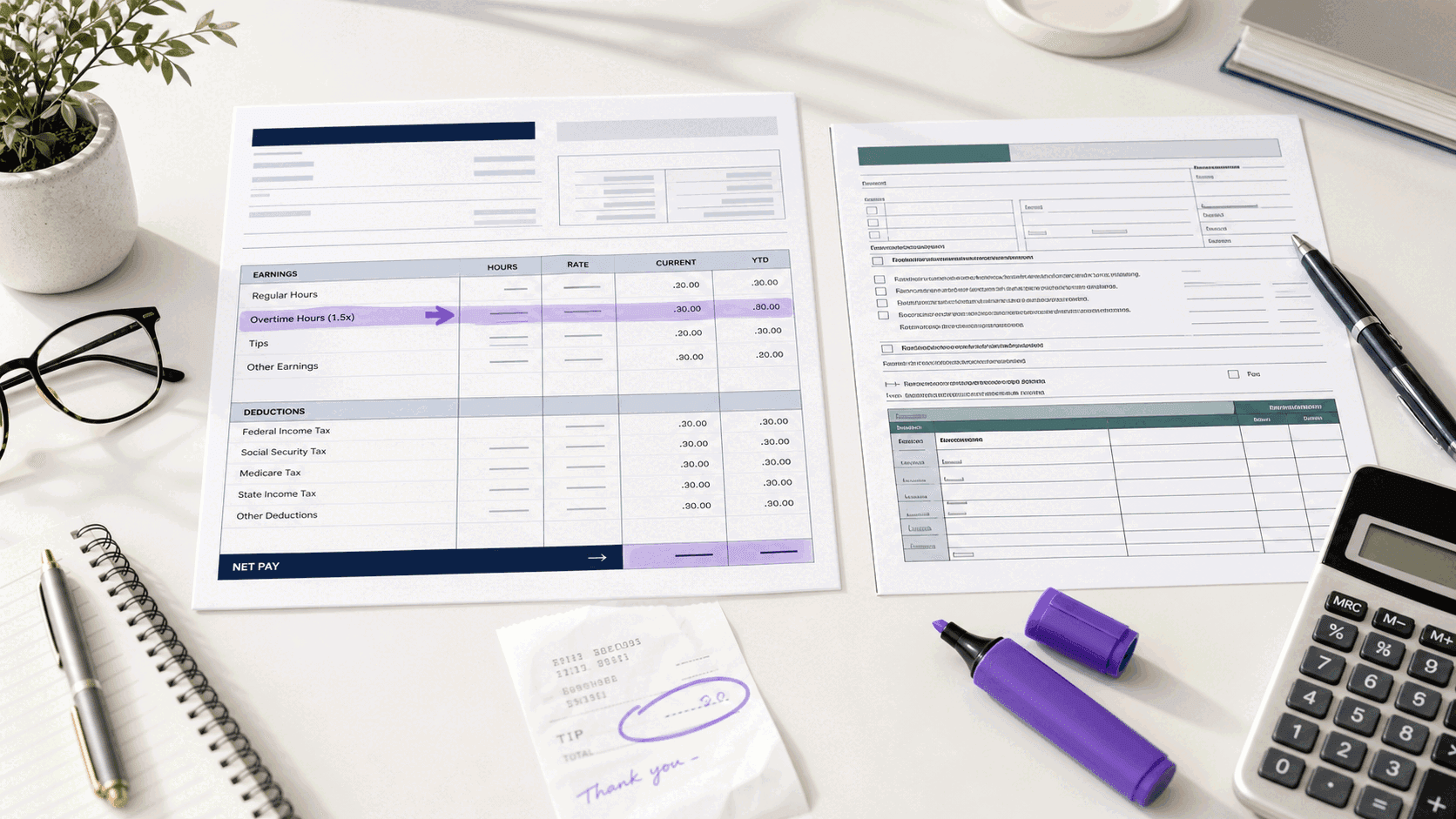
- W-2 reporting. Qualified overtime is now reported separately, in Box 12 with code TT. The number in that box is the FLSA premium — not necessarily the amount you can deduct, since the cap and phase-out still apply on your return.
- The W-4. The 2026 Form W-4 Deductions Worksheet now has lines for expected tips and for the "and-a-half" portion of overtime. The result goes on line 4(b), and that is the only lever that turns the deduction into money in your monthly paycheck instead of a bigger refund.
Whether you use that lever is a genuine choice, not an obvious win. A larger refund is an interest-free loan to the government; an over-aggressive 4(b) is an underpayment you find out about in April. If your overtime is steady, adjusting is reasonable. If it swings with the season, leaving withholding alone and taking the refund is the safer version.
What it is notWhat it is not
- It is not a Social Security or Medicare break. FICA comes out of tips and overtime exactly as before, at 7.65% of wages. A deduction against income tax does nothing to payroll tax. The same split is why a flat car allowance costs more than a mileage reimbursement under an accountable plan: the allowance is wages, so both taxes apply. Pre-tax payroll contributions are different: money put into an HSA or FSA through payroll skips the 7.65% as well, as HSA vs FSA for 2027 works out.
- It is not automatic for your state. State income tax follows state law, and most states did not copy this. Your state may tax the whole amount. And if you work days in another state, that state can tax those days too, which is the same rule that sends an NFL quarterback a nonresident tax bill for every road game.
- It is not a reason to chase overtime. Roughly a fifth to a third of the premium comes back through the deduction. The hours are still hours.
Your numbersWorking out your own number
Three steps, and the only hard input is one you can read off a payslip.
1. Find the premium, not the pay. On a weekly payslip, take your overtime hours and multiply by half your regular hourly rate. That — not the overtime line — is the qualified amount.
2. Multiply by your marginal rate. The deduction lowers taxable income, so the saving is the deduction times the bracket you are in, not the deduction itself. A $4,000 premium saves $880 at 22% and $480 at 12%.
3. Check the phase-out. Above $150,000 of MAGI ($300,000 joint), knock $100 off the deduction for every $1,000 over before you do step 2.
The Paycheck Calculator is the fastest way to see what the underlying paycheck looks like — federal, state, FICA and the rest — before you start reasoning about a deduction on top of it. If you are trying to decide whether to change line 4(b), the Tax Refund Calculator shows the other side of the same decision: what happens to the refund you are used to.
FAQFrequently asked questions
Do I get the money in my paycheck or at tax time? At tax time, unless you file a 2026 W-4 with an amount on line 4(b). Withholding does not know about the deduction until you tell it.
Is my overtime really tax-free now? No. The premium portion, up to $12,500, comes off your taxable income for federal income tax. Federal tax on the rest, FICA, and usually state tax all continue.
I am a contractor who works long hours. Does this apply? No. The overtime deduction is tied to FLSA-covered employment. Self-employment income has no qualified overtime, whatever the hours look like.
My employer pays double time. Does all of it count? Only the part the FLSA requires — the half above your regular rate. The extra generosity is ordinary wages.
Are service charges tips? No. A mandatory charge is wages. Qualified tips have to be voluntary.
Married filing separately — can I claim it? No. Both deductions require a joint return if you are married.
What if my income is above the threshold? The deduction shrinks by $100 for every $1,000 of MAGI over $150,000 ($300,000 joint) and eventually reaches zero — around $275,000 for the overtime deduction, around $400,000 for tips.
Next stepBefore you change anything
Look at one payslip and find the overtime premium. Multiply it by 52. Multiply that by your bracket. That number is what this whole topic is worth to you — and it is the number to have in hand before deciding whether to touch your W-4 or leave the refund alone. Tipped and hourly workers on modest pay have another federal benefit starting in 2027: the Saver's Match adds up to $1,000 a year to retirement savings of $2,000 or more.
This is a plain-English summary of rules that have moved twice in a year, not tax advice. The IRS guidance is the authority, and a payroll department or a tax preparer is the right place to confirm your own case.