Most credit advice is a list of things you should do. Almost none of it says how much each one is worth, which is the only part that helps you choose. Paying a card down and opening a new account are not the same size of decision, and treating them as equal is how people spend six months on the thing that mattered least.
Here is what the score is actually made of, which levers move fastest, and how long the bad ones stick around.
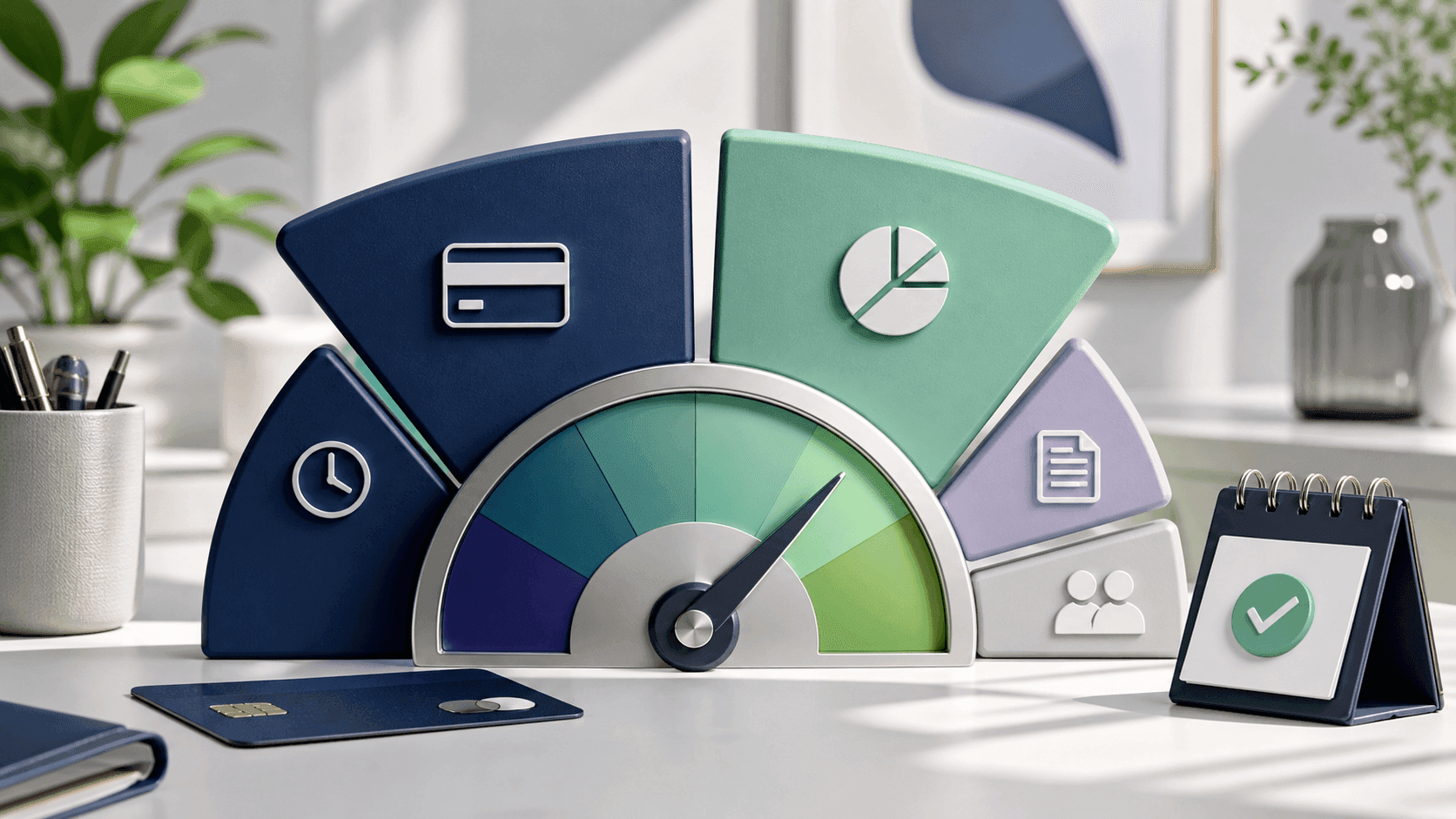
The five factorsThe five things a FICO score is built from
FICO publishes the weights, and they have not changed in years:
- Payment history — about 35%. Whether you pay on time. The single biggest block.
- Amounts owed — about 30%. Mostly your credit utilization: how much of your available credit you are using.
- Length of credit history — about 15%. How long your accounts have been open, and their average age.
- New credit — about 10%. Recent applications and newly opened accounts.
- Credit mix — about 10%. Whether you handle more than one type of credit (cards, an auto loan, a mortgage).
Two blocks are two thirds of the score. If you only ever act on payment history and utilization, you are working on the part that matters.
UtilizationUtilization is the fastest lever you have
Utilization is your balances divided by your total credit limits. It is recalculated every time your issuers report — usually monthly — which makes it the one big factor that can move in weeks rather than years.
A few things people get wrong about it:
- It is not about what you spend, it is about what gets reported. The balance on your statement date is usually the one that lands on your report, even if you pay in full a week later. Paying before the statement closes can lower reported utilization without changing anything about how you live.
- Both numbers matter. Overall utilization across all cards, and the utilization of each individual card. One maxed card can hurt while your overall number looks fine.
- Zero is not the target. Reporting something small generally reads better than reporting nothing at all on every card.
- It has no memory. Unlike a missed payment, high utilization does not leave a scar. Bring the balance down and the factor stops dragging on the next report.
That last point is why utilization is worth doing first: it is the only major factor that responds quickly and forgives completely.
Payment historyPayment history is slow to build and slow to forgive
A payment is normally only reported late once it is 30 days past due. Buy-now-pay-later plans are a different case: on-time payments generally do not count toward a score at all, which buy now, pay later on Black Friday explains. Being a few days late costs you a fee and your issuer's patience, not your score. Most few-days-late payments are a timing problem — a bill due just before payday; bills by paycheck shows how to line due dates up with pay.
Once it is reported, though, it is durable: a late payment can stay on your report for around seven years, and the newer it is, the more it weighs. It fades gradually rather than disappearing on a schedule you can plan around.
The practical consequence: there is no clever move that repairs payment history. Autopay on the minimum for every account, so a bad month can cost you interest but never a mark. Then let time do the rest.
New creditNew credit: small, temporary, and often over-feared
A hard inquiry from applying for credit typically knocks off a handful of points and is only counted for about a year, though it stays visible for two. Several inquiries for the same type of loan in a short window — mortgage or auto shopping — are usually treated as one.
The bigger effect of opening an account is indirect: a new account lowers the average age of your history, which touches the 15% block. Opening a card to chase a signup bonus a month before a mortgage application is the version of this that actually costs money.
Closing cardsClosing an old card usually hurts twice
It is the most common self-inflicted wound. Closing a card removes its limit from your total available credit, so your utilization jumps even though you owe exactly the same amount. And eventually it stops contributing to the age of your history.
If a card has no annual fee, leaving it open and using it once in a while is almost always the better call.
Your numbersPut your own numbers in before you act
General weights tell you what to focus on. They do not tell you what your situation is worth, because the same change lands differently depending on where you start — the same drop in utilization does more for someone at 80% than for someone at 25%.
The Credit Score Simulator takes your current score, your utilization, your missed payments, your hard inquiries and your on-time streak, and shows the direction and rough size of the move. Change one input at a time and you can see which lever is actually yours to pull.
Be clear about what it is: an estimate built on how FICO-style scoring is known to behave, not a reading of your real report. Your actual score comes from a bureau, using your actual file. Use the simulator to rank your options, not to predict a number to the point.
Order of operationsA sane order of operations
- 01Turn on autopay for at least the minimum everywhere. This protects the 35% block permanently.
- 02Find your highest-utilization card and work it down first. The Credit Card Payoff Calculator tells you what a target date costs per month. Highest-utilization first is a scoring choice, not a payoff strategy; for the payoff order itself, Ramsey’s smallest-first snowball has a measurable price.
- 03Pay before the statement date, not just before the due date, if you want reported utilization to fall faster.
- 04Stop opening things in the six to twelve months before a mortgage or auto loan. (For a car, the score sets the rate; the term and the down payment decide how long you owe more than the car is worth — see car loan vs lease in 2026.)
- 05Leave old no-fee cards open.
- 06Track the balances in one place so you can see utilization fall — the Debt Payoff Tracker keeps every account and payoff date together.
FAQFrequently asked questions
How fast can utilization change my score? It can show up on your next report, so weeks rather than months, because issuers usually report balances monthly. It is the fastest of the major factors.
How long does a missed payment hurt? A payment reported 30 days late can stay on your report for around seven years, weighing most when it is recent and fading as it ages. There is no trick that removes an accurate one.
Does checking my own score lower it? No. Checking your own is a soft inquiry and does not affect your score. Only a hard inquiry from applying for credit does.
Should I close a credit card I no longer use? Usually not, if it has no annual fee. Closing it removes its limit from your utilization and eventually stops it counting toward the age of your history.
Is a simulator the same as my real score? No. A simulator estimates the direction and rough size of a change based on published scoring behaviour. Your real score is calculated by a bureau from your actual file, and lenders may use different versions of it.
Next stepTry it on your own numbers
Open the Credit Score Simulator, enter where you are today, then change one habit at a time. The point is not the number it prints — it is seeing which of the five blocks your effort belongs in.