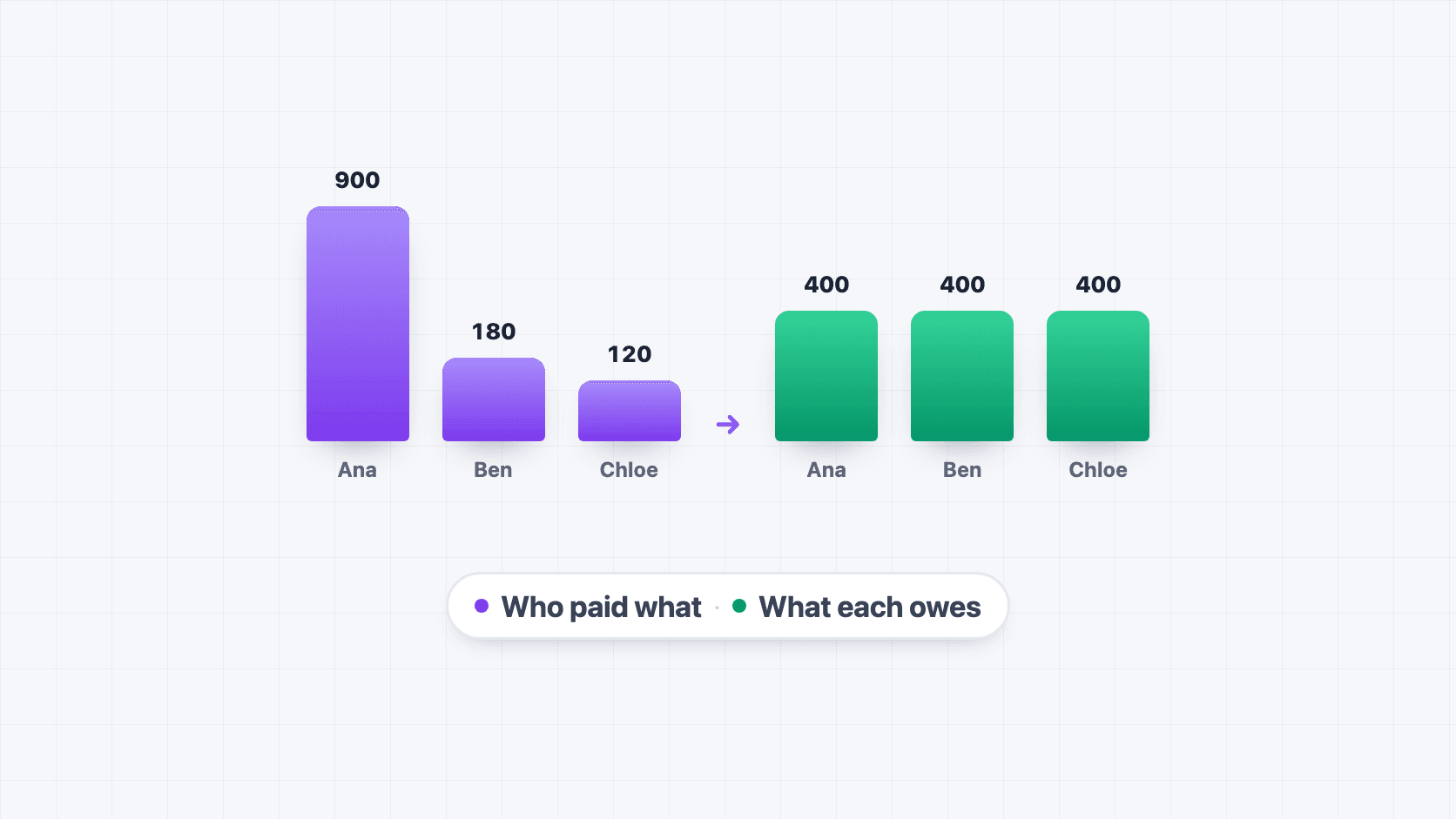
Monthly bills and biweekly paychecks run on two different clocks. Rent is due on the 1st, the car payment on the 15th, the credit card on the 25th — but the paycheck lands every other Friday, and every other Friday drifts across the month. So the same $2,100 paycheck can have $460 of bills to cover one time and $1,910 the next.
That swing is why "half the bills from each paycheck" feels right and still runs short. This guide shows the method that works instead — assign each bill to the paycheck that arrives before it — using one household's real 2027 calendar, and explains the two paychecks a year that the monthly budget never counts.
The problemWhy half-and-half runs short
Take a household paid $2,100 every other Friday, with nine monthly bills totalling $2,542:
Rent
- Due on
- 1st
- Amount
- $1,450
Car insurance
- Due on
- 5th
- Amount
- $142
Streaming
- Due on
- 8th
- Amount
- $35
Internet
- Due on
- 12th
- Amount
- $70
Car payment
- Due on
- 15th
- Amount
- $385
Electricity
- Due on
- 20th
- Amount
- $135
Phone
- Due on
- 22nd
- Amount
- $85
Credit card
- Due on
- 25th
- Amount
- $200
Gym
- Due on
- 28th
- Amount
- $40
| Bill | Due on | Amount |
|---|---|---|
| Rent | 1st | $1,450 |
| Car insurance | 5th | $142 |
| Streaming | 8th | $35 |
| Internet | 12th | $70 |
| Car payment | 15th | $385 |
| Electricity | 20th | $135 |
| Phone | 22nd | $85 |
| Credit card | 25th | $200 |
| Gym | 28th | $40 |
Source: CalculatorAI · calculatorai.app · Illustrative household
The intuitive plan is to split the bills down the middle: $1,271 from each paycheck, $829 left to live on. On average that is correct. In practice it fails 12 times in 2027, because rent alone is $1,450 — more than half the monthly bills — and it is due on one day. Whichever paycheck comes just before the 1st has to carry it. In the worst period of the year, the bills due before the next payday add up to $1,910: the half-and-half plan set aside $1,271 and comes up $639 short.
A short paycheck is how bills get paid late. A payment 30 days past due can be reported to the credit bureaus and stays on a credit report for years — what moves your credit score shows how much that one line weighs — and since a federal court threw out the CFPB's $8 card late-fee cap in April 2025, the fee in your card agreement applies again.
The methodGive each bill to the paycheck before it
The rule is simple: a paycheck pays every bill that falls due before the next paycheck arrives. Anything due on or after the next payday waits for that paycheck. Here is what the rule produces for the household above across 2027:
Fri, Jan 8
- Bills it covers
- Streaming, internet, car payment, electricity
- Bills
- $625
- Left to live on
- $1,475
Fri, Jan 22
- Bills it covers
- Phone, credit card, gym, February rent
- Bills
- $1,775
- Left to live on
- $325
Fri, Feb 19
- Bills it covers
- Electricity, phone, card, gym, March rent
- Bills
- $1,910
- Left to live on
- $190
Fri, Apr 16
- Bills it covers
- Electricity, phone, credit card, gym
- Bills
- $460
- Left to live on
- $1,640
Fri, Apr 30
- Bills it covers
- May rent, insurance, streaming, internet
- Bills
- $1,697
- Left to live on
- $403
Fri, Oct 15
- Bills it covers
- Car payment, electricity, phone, card, gym
- Bills
- $845
- Left to live on
- $1,255
| Payday | Bills it covers | Bills | Left to live on |
|---|---|---|---|
| Fri, Jan 8 | Streaming, internet, car payment, electricity | $625 | $1,475 |
| Fri, Jan 22 | Phone, credit card, gym, February rent | $1,775 | $325 |
| Fri, Feb 19 | Electricity, phone, card, gym, March rent | $1,910 | $190 |
| Fri, Apr 16 | Electricity, phone, credit card, gym | $460 | $1,640 |
| Fri, Apr 30 | May rent, insurance, streaming, internet | $1,697 | $403 |
| Fri, Oct 15 | Car payment, electricity, phone, card, gym | $845 | $1,255 |
Source: CalculatorAI · calculatorai.app · Computed with the Bill Tracker's paycheck engine; biweekly Fridays from October 2, 2026
The spending money is not $829 every two weeks. It is $1,475, then $325, or $1,640, then $403 — and the year's lightest and heaviest paychecks are only two months apart. The danger is entirely in the light paycheck: it looks like a windfall, and it is followed by the rent paycheck.
Due datesMoving one bill changes the worst paycheck
Many lenders, card issuers and utilities let you choose your due date — usually by a phone call or a setting in the account. Moving the right bill can shave the worst paycheck.
The heaviest paycheck drops from $1,910 to $1,710
In this household the heavy windows are the ones that hold rent plus the late-month bills. Moving the $200 credit-card due date from the 25th to the 15th takes it out of the rent window most of the year. The heaviest paycheck falls by $200; the lightest falls from $460 to $260 — the load evens out without changing a single amount. Moving bills toward the 1st makes it worse, not better: those join rent.
Because biweekly paydays drift through the month, no set of due dates balances every paycheck perfectly — the windows move by a few days each month. The useful target is the worst paycheck, not the average one.
Extra paychecksThe two months with three paydays
A biweekly schedule pays 26 times a year, not 24. A budget built on "two paychecks a month" quietly ignores two of them — $4,200 a year for this household. On the Friday schedule above they fall in April and October 2027, each of which has three paydays (April 2, 16 and 30; October 1, 15 and 29).
Because the bills are monthly, those extra paychecks carry almost nothing extra: the April 16 paycheck in the table above covered just $460. That makes them the natural place to fund what a monthly budget forgets — the annual insurance premium, the emergency fund, a debt you want gone. Decide the destination before the month starts; an unplanned extra paycheck tends to disappear into ordinary spending.
Set it upThe bills-by-paycheck routine
List every bill with its due day and amount
Rent, utilities, insurance, loan payments, phone, internet, subscriptions, card payments. For bills that vary, use a typical month and adjust when the statement arrives.
Enter your pay schedule
Biweekly, weekly, twice a month or monthly, one recent payday, and the net amount that lands in your account.
Assign each bill to the paycheck before it
Everything due before the next payday belongs to the current one. Overdue bills ride on the current paycheck too — they are owed out of the money you have now.
Mark bills paid as you pay them
What is left on the current paycheck is your real spending money for the next two weeks.
Plan the two extra paychecks
Write down now what the third paycheck in each three-paycheck month will fund.
The free Bill Tracker does the assignment for you. Enter your bills and your pay schedule once — the Paycheck Calculator can fill in the net amount — and the By paycheck view shows which paycheck covers which bills and what is left after each one, with overdue bills placed on the current paycheck. Due dates also go on a month calendar with a reminder a few days before each one, and the Analytics view counts how often a bill was paid late and the late fees at risk. Autopay bills are marked paid on their due date; everything else stays unpaid until you mark it, so nothing is assumed.
If the bills-by-paycheck sheet shows too little left after the heavy paycheck, the fix is on the spending side: a 50/30/20 budget gives a target for how much of take-home pay fixed bills should take, and a subscription audit is the fastest way to find bills you no longer use. A small buffer in checking — even one heavy paycheck's worth of shortfall — removes the timing risk entirely; how much emergency fund do you need covers the larger cushion.
ChecklistSigns your bill schedule needs fixing
One paycheck leaves almost nothing
If the rent paycheck leaves under a couple of hundred dollars, a single variable bill coming in high can push a payment late. Hold money back from the light paycheck or move a due date.
You pay a bill late at the same point every month
That is a timing problem, not a money problem. Look at which paycheck the bill falls on and move its due date into a lighter window.
The extra paychecks vanish
Two paychecks a year that nobody planned for usually become ordinary spending. Assign them in advance.
Autopay draws before payday
An automatic payment dated the day before your paycheck arrives can overdraw the account. Set autopay dates a day or two after payday.
Bills live in four different apps
When due dates are spread across bank, card and utility logins, the overview — not the money — is what is missing. Put them in one list.
Where these numbers come from
- Household: nine fixed monthly bills totalling $2,542 (amounts and due days in the first table) and a net paycheck of $2,100 every other Friday, with October 2, 2026 as a payday. Amounts are illustrative; real bills vary, which makes the heavy paycheck heavier in some months.
- Assignment: each paycheck covers the bills due from its payday through the day before the next payday — the same rule the Bill Tracker's By paycheck view uses. The figures were computed with that view's own engine for every paycheck dated in 2027 (26 paychecks): heaviest $1,910 (February 19, March 19 and August 20), lightest $460 (April 16 and September 17).
- Half-and-half plan: $2,542 ÷ 2 = $1,271 set aside per paycheck; a paycheck is "short" when the bills due before the next payday exceed $1,271 — 12 of the 26 paychecks in 2027, by up to $639.
- Due-date change: the credit card moved from the 25th to the 15th, all else equal; tested against other due days for the car payment and the card, this was the move that lowered the heaviest paycheck the most.
- Three-paycheck months: paydays counted per calendar month for the Friday schedule above. A different payday puts the three-paycheck months in different months of the year, but every biweekly schedule has two most years.
- Late-fee rules: the CFPB's 2024 rule capping most credit-card late fees at $8 was vacated by a federal court in April 2025; your card agreement states the fee that applies.
FAQFrequently asked questions
How do I split monthly bills between biweekly paychecks?
Assign each bill to the paycheck that arrives before its due date: a paycheck pays everything due before the next payday. Don't split the total in half — a large bill like rent makes one paycheck much heavier than the other.
Which paycheck should pay rent?
The one that arrives before the 1st. On a biweekly schedule that changes every month or two, so check the calendar, not a fixed rule — or keep part of the previous, lighter paycheck in reserve for it.
What are three-paycheck months?
With biweekly pay you get 26 paychecks a year, so two months have three paydays. Most monthly bills are already covered by then, which makes the third paycheck a good source for savings, debt payments or annual bills.
Can I change the due date of my bills?
Often, yes. Many card issuers, lenders and utilities let you choose a due date by phone or in your account settings. Moving one or two bills can even out the load between paychecks.
What happens if I pay a bill a few days late?
Usually a late fee, and for some accounts a higher interest rate. Credit reporting generally starts when a payment is 30 days past due, so a few days late is costly but rarely shows on your credit report — 30 days late does.
Is it better to be paid biweekly or twice a month?
Twice a month lines up more neatly with monthly bills. Biweekly pays slightly more often — 26 paychecks instead of 24 — so the same annual salary gives two extra paychecks to plan around.
Pay from the right paycheck
Monthly bills and biweekly pay will never line up on their own. Assign every bill to the paycheck before it, watch the heavy paycheck rather than the average, move a due date when one paycheck is overloaded, and give the two extra paychecks a job before they arrive.
Put your bills and pay schedule into the free Bill Tracker to see the By paycheck view for your own calendar, with reminders before every due date.