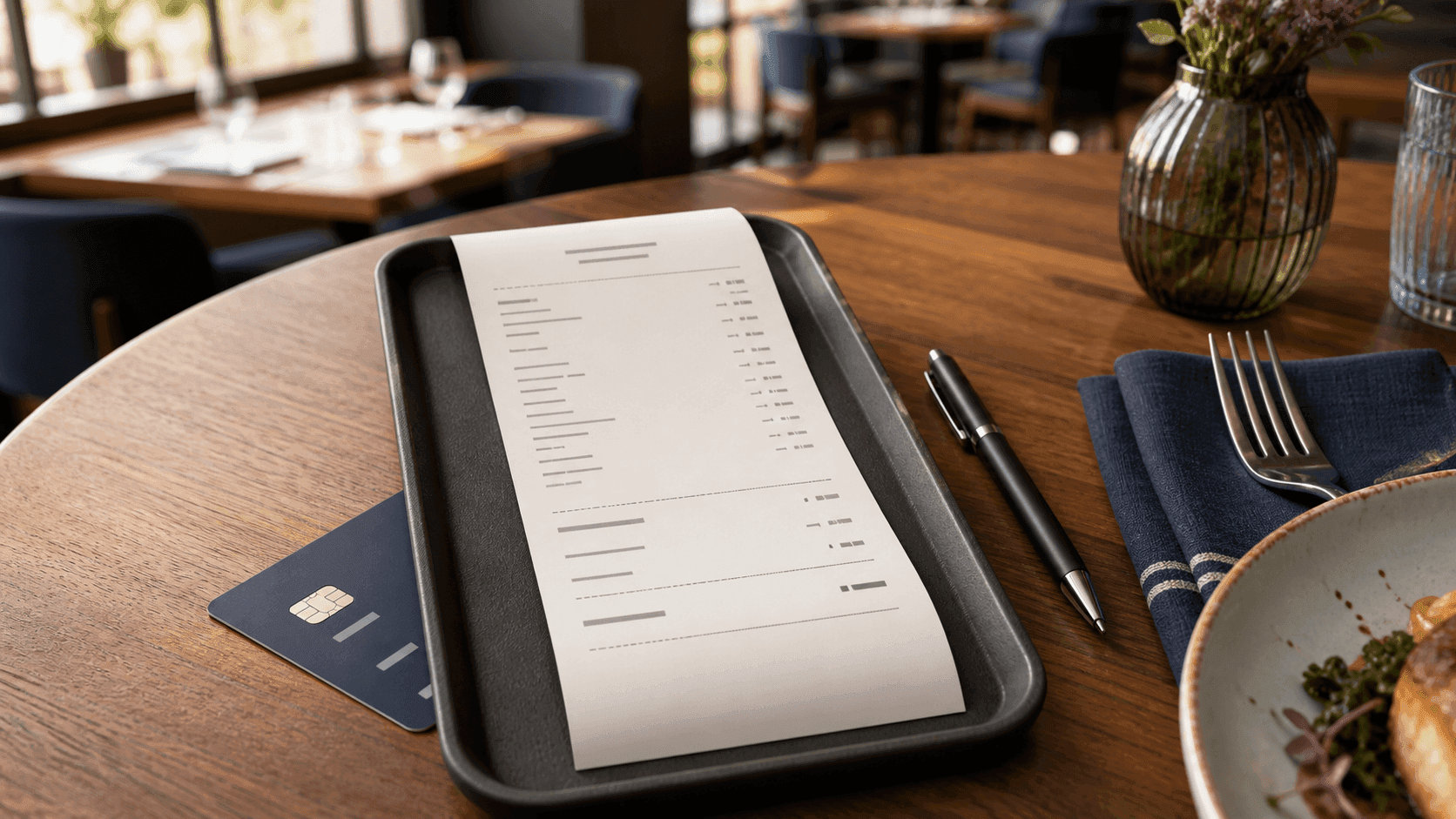
A restaurant receipt looks trivial until you need one that holds up — a customer asking for a copy to expense, a diner who paid cash, a delivery order, or your own bookkeeping at the end of a week. The format is not complicated, but leaving out one line is what turns it into a document nobody can use.
Here is what belongs on it, the two parts people get wrong, and the fastest way to produce one.
Required fieldsWhat has to be on it
Every restaurant receipt should carry:
- Your business name and address, plus a phone number or website.
- A receipt number — any sequence, as long as it never repeats.
- The date and time of the sale. Time matters more here than in most trades: it separates lunch from dinner service and settles disputes about which visit a charge belongs to.
- The itemised lines — each dish or drink, quantity, unit price, line total.
- The subtotal, before tax and before tip.
- Tax, shown as its own line with the rate.
- Tip or service charge, if there is one, on its own line.
- The total actually paid.
- How it was paid — cash, card, or transfer. For a card, the last four digits and nothing more.
- Table or order number, and the server, if you run table service.
If the receipt might be used to reclaim tax, a customer will also need your tax or VAT registration number on it. That is the one field people leave off and then get asked for a week later.
Tip and taxTip and tax are where receipts go wrong
Two rules save most of the confusion:
Tax is calculated on the subtotal, not on the tip. Add up the items, apply tax to that number, then add any tip on top. A receipt that taxes the tip is wrong and, in a business context, awkward to explain.
A tip and a service charge are not the same thing. A tip is voluntary and added by the customer; a service charge is one you apply yourself, often for large parties. Label whichever one it is, because they are treated differently for accounting and, in many places, for tax.
If you split a bill across several people, issue a receipt per payment rather than one receipt with several totals. (Splitting recurring costs at home is a different problem — see how to split expenses with roommates.) Anyone expensing their share needs a document with their own amount on it.
Cash salesCash sales deserve more care, not less
There is no card statement backing a cash sale, so the receipt is the only record it happened. Give one for every cash transaction, keep your copy, and make sure the numbering runs unbroken. A gap in the sequence is the first thing that raises a question in a review. The broader guide on how to make a receipt for payment covers the same record for card, PayPal, Venmo and Zelle sales, and for service businesses.
The fast wayThe fastest way to produce one
You do not need a design tool or a spreadsheet:
- 01Open the Receipt Generator.
- 02Describe the sale in a sentence — what was ordered, the amount and how it was paid — and the AI fills the fields for you. Correct anything it got wrong.
- 03Check the three numbers that matter: subtotal, tax, total. Tax on the subtotal only.
- 04Add your logo if you want the receipt to look like it came from your restaurant.
- 05Download the PDF and send or print it. No watermark, on the free plan.
If you would rather start from a layout, the receipt templates cover cash, card and bank payments and are the same underlying document.
Record keepingKeep the copies somewhere you can find them
Whether you issue receipts or collect them, the useful part is being able to find one months later. Filing them in the Expenses Tracker as you go means the total, date and category are already recorded and you are not reading faded thermal paper at tax time.
FAQFrequently asked questions
Is a restaurant receipt the same as an invoice? No. A receipt is proof that payment has already been made. An invoice is a request for payment. (How to create one — the fields, the terms, the due date — is a separate guide.) If a customer is paying later — a corporate account, an event booking — you want an invoice instead.
Do I have to itemise every dish? For a customer expensing a meal, yes — an itemised receipt is what most expense policies require. A total-only slip is often rejected.
Should tax be charged on the tip? No. Apply tax to the subtotal of the items; the tip sits on top and is not taxed.
Can I reissue a receipt a customer lost? Yes. Reissue it with the same receipt number and the original date, so your records still tie out. Do not give it a new number — that would look like a second sale.
How long should I keep them? Long enough to cover the record-keeping period where you operate; several years is typical. Digital copies are usually acceptable and do not fade the way till rolls do.
Next stepMake one now
Open the Receipt Generator, describe the sale, and download the PDF. It takes about a minute, and the result is a document a customer can actually submit.