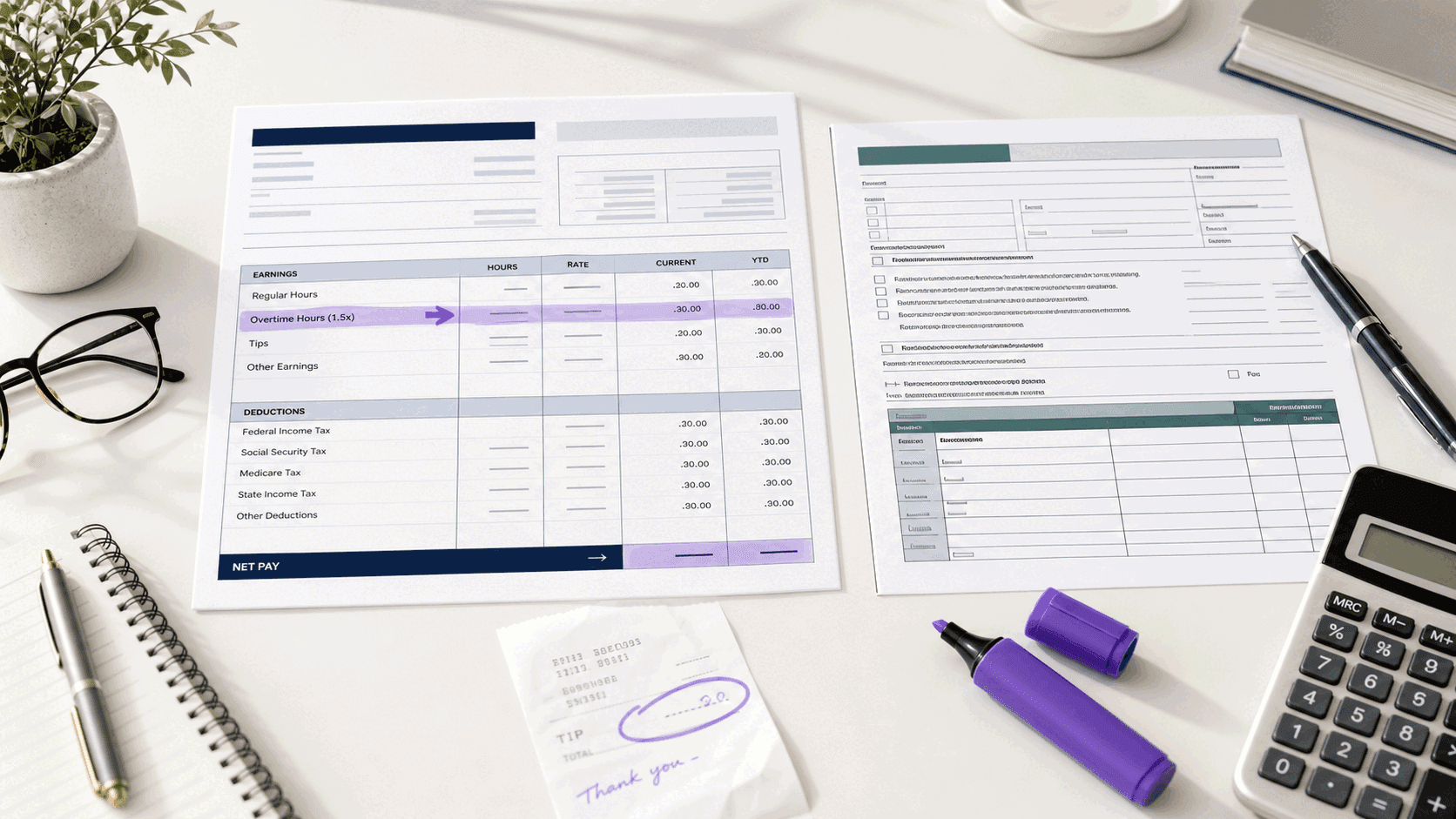
If you are scheduled for Thanksgiving on November 26 or Christmas on Friday, December 25, the short answer is the one most people do not expect: federal law does not require a private employer to pay you anything extra for working a holiday. Time-and-a-half or double time on a holiday is common, but it comes from your employer's policy, a union contract or, in a few places, state law — not from the federal rulebook.
The longer answer matters more, because the rules that do exist interact in a way that surprises even payroll staff. At $18 an hour, a time-and-a-half Thanksgiving shift adds $72 to a normal 40-hour week. In a week where Thanksgiving pushes you to 48 hours, the same premium can add $0 — because the law lets the employer count it as the overtime it already owed you. This guide works through both cases with real numbers, plus paid holidays you do not work, part-timers, how holiday pay is taxed and what the 2025–2028 "no tax on overtime" deduction does and does not cover.
Who this is for: hourly employees of private businesses in the US who are non-exempt — the term for workers covered by federal minimum-wage and overtime rules, which is most hourly staff in retail, restaurants, warehouses, hospitals, call centers and security. What it notes only briefly: salaried exempt staff, union members (your contract decides most of this) and federal employees, who have their own law. If you run payroll, there is a short section for you near the end. This is a guide to how the rules work, not legal advice for your situation.
The federal ruleNo law requires holiday pay
The Fair Labor Standards Act (FLSA) is the 1938 federal law that sets the minimum wage and overtime for most US employees. It is silent on holidays in both directions. The Department of Labor puts it plainly: the FLSA "does not require payment for time not worked, such as vacations, sick leave or holidays," and it "does not require extra pay for weekend or night work" (DOL, FLSA questions and answers). Its overtime page adds that the law does not require overtime pay for work on holidays or weekends unless overtime hours are actually worked on those days (DOL, Overtime Pay).
What the FLSA does require is overtime: at least 1.5 times your regular rate for every hour worked over 40 in a workweek. Two of those words carry the whole article:
- Workweek — a fixed, recurring 168-hour period your employer sets, such as Sunday 12:00 a.m. to Saturday 11:59 p.m. Each week stands alone; hours are never averaged across two weeks.
- Regular rate — not simply your hourly wage. It is everything you were paid for the hours worked that week, divided by those hours. A night differential, for example, raises it (see shift differential pay). Some payments are left out of it by law, and a holiday premium of time-and-a-half or more is one of them — which is where holiday pay and overtime meet.
So in 2026 the federal picture for a private, non-exempt employee is:
Overtime after 40 hours
Hours worked on Thanksgiving or Christmas count toward the 40 like any other hours. Over 40, at least 1.5 times the regular rate.
Holiday premium or a paid day off
Time-and-a-half or double time for working the holiday, and pay for a holiday you take off, exist only if your employer, contract or state provides them.
How common the paid day off is, at least, is measured. In March 2026, 81% of private-industry workers had access to paid holidays — 92% of full-time workers but only 47% of part-timers, and 56% in service occupations (BLS Employee Benefits Survey, table 6, published September 2026). How many employers pay a premium for working a holiday is not something BLS or any survey we could verify publishes, so we do not guess at a figure. Your handbook or contract is the only reliable source for yours.
The datesHolidays in this season
For employers that follow the federal calendar, the late-2026 holidays fall on these days (OPM federal holidays):
- Thanksgiving Day: Thursday, November 26, 2026.
- Christmas Day: Friday, December 25, 2026.
- New Year's Day: Friday, January 1, 2027 — note that this shift is paid in the 2027 tax year if it falls in a January pay period.
A private employer is free to choose which days are "holidays" for its own pay policy. Many retailers treat the day after Thanksgiving or Christmas Eve as ordinary days; others add them. If a policy says "holiday pay on recognized holidays," the list it recognizes is the one that counts.
One shiftWhat a holiday premium is worth
At $18 an hour, one 8-hour holiday shift pays:
No holiday premium (the federal minimum)
- Pay for the shift
- $144
- Extra over a normal day
- $0
Time-and-a-half (1.5×)
- Pay for the shift
- $216
- Extra over a normal day
- $72
Double time (2×)
- Pay for the shift
- $288
- Extra over a normal day
- $144
| Employer policy | Pay for the shift | Extra over a normal day |
|---|---|---|
| No holiday premium (the federal minimum) | $144 | $0 |
| Time-and-a-half (1.5×) | $216 | $72 |
| Double time (2×) | $288 | $144 |
Source: CalculatorAI · calculatorai.app · CalculatorAI arithmetic · drafts/holiday-pay-rules-2026-numbers.mjs
Work all three — Thanksgiving, Christmas and New Year's Day — in otherwise ordinary weeks and time-and-a-half adds $216 to the season; double time adds $432. That is real money, but it is smaller than it feels when the shift is being offered, and it is worth knowing before you trade a family day for it.
OvertimeWhere the holiday premium and overtime meet
Here is the part that catches people out. The FLSA treats a holiday premium of at least 1.5 times your normal rate in two special ways:
- It is left out of the regular rate, so it does not push up your overtime rate (29 U.S.C. § 207(e)(6)).
- It is creditable toward overtime — the employer may count the extra holiday money against the overtime premium it owes for that week (29 U.S.C. § 207(h)(2)).
The Labor Department's regulation spells out the other side: a holiday premium below time-and-a-half must be included in the regular rate and "cannot be credited toward statutory overtime due" (29 CFR 778.203). Its own worked examples for holiday work at time-and-a-half and at double time follow exactly this logic (29 CFR 778.219(b)).
0.5 × regular rate × hours worked over 40kept out of the regular rate; counts toward the overtime aboveadded into the regular rate; overtime is still owed on topNow take the same $18-an-hour worker in Thanksgiving week: 40 hours on the other days, plus 8 hours on Thanksgiving — 48 hours, 8 of them over 40.
No holiday premium
- How overtime is met
- 8 overtime hours at $27
- Gross for the week
- $936
1.5× holiday, FLSA minimum
- How overtime is met
- The $72 holiday premium is credited as the $72 overtime premium
- Gross for the week
- $936
1.25× holiday
- How overtime is met
- Premium goes into the regular rate ($18.75); $75 overtime on top
- Gross for the week
- $975
2× holiday
- How overtime is met
- $144 premium covers the $72 overtime; nothing more owed
- Gross for the week
- $1,008
1.5× holiday and overtime paid separately
- How overtime is met
- Employer policy (or state law) pays both
- Gross for the week
- $1,008
| Holiday policy | How overtime is met | Gross for the week |
|---|---|---|
| No holiday premium | 8 overtime hours at $27 | $936 |
| 1.5× holiday, FLSA minimum | The $72 holiday premium is credited as the $72 overtime premium | $936 |
| 1.25× holiday | Premium goes into the regular rate ($18.75); $75 overtime on top | $975 |
| 2× holiday | $144 premium covers the $72 overtime; nothing more owed | $1,008 |
| 1.5× holiday and overtime paid separately | Employer policy (or state law) pays both | $1,008 |
Source: CalculatorAI · calculatorai.app · 29 U.S.C. § 207(e)(6), (h)(2); 29 CFR 778.203, 778.219(b); CalculatorAI arithmetic · drafts/holiday-pay-rules-2026-numbers.mjs
Read the second row twice. A worker who would have done 48 hours anyway is paid exactly the same $936 whether Thanksgiving carries a time-and-a-half premium or not. Nothing has gone wrong: the holiday hours are simply the overtime hours, paid at time-and-a-half once rather than twice. Federal law does not require "pyramiding" — paying overtime on top of a holiday premium for the same hours.
The odd-looking third row is just as real. A 1.25× holiday rate is a smaller premium, but because it is below 1.5× the law treats it like a differential: it raises the regular rate, and full overtime is still owed. In this week it ends up paying $39 more than the 1.5× policy.
Paid holiday you do not work
A paid day off works the other way round. If you take Thanksgiving off with 8 hours of holiday pay and work 40 hours on the other days, you are paid for 48 hours but worked only 40 — so under the FLSA there is no overtime, and the week pays $864. Hours not worked do not count toward the 40, and pay for them is neither part of the regular rate nor creditable toward overtime (29 CFR 778.219(a); DOL Fact Sheet #56A). Some employers count paid holidays toward overtime anyway by policy; in this week that would add $72, for $936. It is a fair question to ask, and the answer is in writing somewhere.
Part-timers
No federal rule gives part-time workers holiday pay either — and the BLS figure above shows that fewer than half have it. Where a policy does cover part-timers, it usually says how the hours are counted, and the method changes the number a lot. For a 24-hour-a-week worker at $18:
- Prorated (24 of 40 hours, applied to an 8-hour holiday = 4.8 hours): $86.40.
- Hours you were scheduled that day (say a 6-hour shift): $108.
- No part-time holiday pay: $0, which is lawful under federal law.
Many policies also add eligibility rules — a minimum length of service, or working the scheduled shifts before and after the holiday. Those are policy terms, not law, so read your own.
State lawRhode Island, Massachusetts and everyone else
Most states add nothing to the federal rule for private employers. Two New England states are the usual exceptions people hear about, and in 2026 only one of them still requires premium pay.
Rhode Island still does. Its Department of Labor and Training lists the legal holidays — including Thanksgiving Day and Christmas Day — and states that "work performed by employees on Sundays and holidays must be paid for at least one and one-half (1½) times the normal rate of pay" (RI DLT, Legal Holidays, read November 12, 2026). The rules sit in R.I. Gen. Laws § 25-3-3 for most employers and § 5-23-2 for retail:
- Many workers are excluded. DLT lists exceptions "including workers in health care, hospitality, agriculture, and commercial fishing" (RI DLT, Labor Standards FAQ); the statute's definition of employee also leaves out restaurant and hotel staff and some others.
- The work must be voluntary. An employee cannot be fired or penalized for refusing Sunday or holiday work; § 25-3-3 makes an exception to that protection for manufacturers that operate seven days a week.
- Most retail stores stay closed on Thanksgiving and Christmas. § 5-23-2 bars most retail establishments from opening on those two days, with exceptions such as pharmacies, small food stores, florists and bakeries. Where retail holiday work is allowed, it is paid at least time-and-a-half with a four-hour minimum.
- Retail versus everyone else on overtime. For a retail business, DLT says the Sunday or holiday hours paid at time-and-a-half "shall be excluded from the calculation of overtime pay" — so the 48-hour week above would be paid like the FLSA-minimum row. Since an August 2025 rule change, DLT reads the law as requiring non-retail employers to pay both the holiday premium and overtime, like the last row (as summarized by Littler, August 8, 2025).
Massachusetts no longer requires holiday premium pay. The 2018 "Grand Bargain" law (Chapter 121 of the Acts of 2018, which also raised the minimum wage and created paid family leave) phased out the retail Sunday and holiday premium, and the Attorney General's office confirms that "premium pay requirements were eliminated effective January 1, 2023" (Mass.gov, Working on Sundays and Holidays, read November 12, 2026). What remains of the state's "Blue Laws" — old rules about which businesses may open on Sundays and holidays — is about opening and consent, not pay:
- Thanksgiving and Christmas are restricted holidays for retail: a store may open only with statewide approval and a local police permit.
- On New Year's Day and other partially restricted holidays retail work needs no permit, but the "voluntariness" rule applies: most retailers cannot require you to work and cannot punish you for refusing.
- Overtime still applies after 40 hours, including hours on a Sunday or holiday.
Everywhere else, check your state labor department for anything specific to your industry — and remember that paid sick leave laws in many states are separate from holiday pay: they let you take paid time off, but they do not create a holiday premium.
Other workersExempt staff, union members and federal employees
Salaried exempt employees — managers and professionals who meet the FLSA's salary and duties tests, and get no overtime — have no right to holiday pay either. One protection does apply: if your employer closes for a holiday and you are ready to work, it generally cannot dock your salary for the closure, because "deductions may not be made for time when work is not available" (29 CFR 541.602).
Union members usually have the most detailed holiday terms of anyone — which days, which rate, whether holiday and overtime are paid on top of each other, who gets first pick of shifts. The contract decides, as long as the result is at least what the FLSA requires.
Federal employees are the one group with holiday premium pay in federal law. A federal worker who does non-overtime work on a holiday gets holiday premium pay "equal to an employee's rate of basic pay" for up to 8 hours — in effect double pay — with a 2-hour minimum (OPM, Federal Holidays — Work Schedules and Pay, citing 5 U.S.C. 5546). At $30 an hour basic, 8 hours on Christmas pay $480 instead of $240. This is the rule people often have in mind when they say "the law says holidays are double time" — it is true only for the federal government's own staff.
The tax sideHow holiday pay is taxed
Holiday pay — premium or paid day off — is ordinary wages. It is subject to federal income tax, Social Security and Medicare (7.65% together) and state income tax like any other hour. There is no special holiday tax rate.
What can look different is the withholding — the tax taken out of the paycheck in advance, which is settled against your real tax when you file. The IRS treats payments such as bonuses and overtime as "supplemental wages." When they are paid together with regular wages and not listed separately, the employer withholds as if the total were one normal paycheck. When they are listed or paid separately, the employer may withhold a flat 22% of federal income tax instead (IRS Publication 15 (2026), section 7). On a $144 double-time premium paid as a separate line that is $31.68 of federal withholding plus $11.02 of Social Security and Medicare. For an $18-an-hour full-timer, whose income falls in the 12% bracket, 22% is more than the tax actually due on that money, and the difference comes back at filing time. It is withholding, not a higher tax.
"No tax on overtime" and holiday premium
From 2025 through 2028, overtime-eligible employees can deduct qualified overtime compensation — up to $12,500 a year ($25,000 joint), reduced at higher incomes. We cover the deduction itself in no tax on tips and overtime. What matters here is that it covers only the FLSA-required premium — the "half" in time-and-a-half on hours over 40 — and the IRS says that where an employer pays more than the FLSA requires, "only the amount minimally necessary" counts (IRS FS-2026-13, Q16, August 2026). Its examples of pay that is not required include premiums "for hours on a weekend or holiday." Where an employer relies on a creditable holiday premium to meet the overtime requirement, only the portion credited counts (Q12).
Applied to the weeks above:
40 hours, 1.5× holiday
- Holiday premium paid
- $72
- Qualified overtime
- $0
- Tax saved
- $0
40 hours, 2× holiday
- Holiday premium paid
- $144
- Qualified overtime
- $0
- Tax saved
- $0
48 hours, 2× holiday
- Holiday premium paid
- $144
- Qualified overtime
- $72
- Tax saved
- $8.64
48 hours, 1.5× holiday
- Holiday premium paid
- $72
- Qualified overtime
- $72
- Tax saved
- $8.64
| Week | Holiday premium paid | Qualified overtime | Tax saved |
|---|---|---|---|
| 40 hours, 1.5× holiday | $72 | $0 | $0 |
| 40 hours, 2× holiday | $144 | $0 | $0 |
| 48 hours, 2× holiday | $144 | $72 | $8.64 |
| 48 hours, 1.5× holiday | $72 | $72 | $8.64 |
Source: CalculatorAI · calculatorai.app · IRS FS-2026-13, Q12 and Q16; CalculatorAI arithmetic · drafts/holiday-pay-rules-2026-numbers.mjs
In a 40-hour week there is no FLSA overtime, so a holiday premium — however generous — is not qualified overtime at all. In a 48-hour week, only the $72 the FLSA requires qualifies, whether the holiday paid 1.5× or 2×. Your employer reports the qualified amount on your W-2 in box 12 with code TT, and that box is what the deduction uses.
Before the shiftWhat to ask your employer
Whether your holiday shift pays more is a question with a written answer. These are the questions that settle it:
Is there a holiday premium, and at what rate?
Time-and-a-half, double time, a flat bonus — and for which days. Ask whether the day after Thanksgiving or Christmas Eve is included.
Which hours does it cover?
Only hours on the calendar date, or the whole shift when a night starts on Christmas Eve and ends on Christmas morning?
Is overtime paid on top of the holiday premium?
Federal law allows a 1.5× holiday premium to count as overtime. Your policy, contract or (in Rhode Island, outside retail) state law may pay both.
Do paid holidays count toward overtime?
Not required by the FLSA. Some employers include them, which changes a 40-hour week with a paid holiday into overtime.
Do part-timers get holiday pay, and how much?
Prorated, scheduled hours or none — plus any rule about working the shifts before and after.
Can I refuse the shift?
Under federal law, generally no protection. In Rhode Island and for many Massachusetts retailers, holiday work must be voluntary.
Where does it appear on my payslip?
A separate holiday line, or folded into regular hours — which also tells you how it will be withheld.
Then check the payslip. The free Shift & Hours Tracker lets you add a holiday differential for specific dates, as a percentage or a flat amount, prices overtime on the regular rate and compares what your logged shifts should have paid with the gross on your payslip. It records the arithmetic; it does not decide a legal question. If the shift was clocked in rounded increments, the 7-minute rule explains how the minutes are supposed to be counted.
For employersGetting holiday pay right
If you run payroll, the same rules from the other side:
Decide the policy and write it down
Which days, which rate, who is eligible, whether paid holidays count toward overtime. A written policy is what an employee can enforce, so it should say exactly what you mean.
Count holiday hours worked toward 40
Always. A holiday line does not remove the hours from the overtime calculation.
Pick a rate of 1.5× or more if you want the credit
Only a premium of at least 1.5× for like work is excluded from the regular rate and creditable toward overtime. A 1.25× premium raises the regular rate instead.
Check state law before you credit
Rhode Island requires premium pay for most employers and, outside retail, treats it as separate from overtime. Massachusetts restricts retail opening on Thanksgiving and Christmas.
Report only FLSA-required overtime in W-2 box 12, code TT
Holiday premium beyond the FLSA minimum is not qualified overtime; the credited portion that meets FLSA overtime is.
Where these numbers come from
- Pay rate: $18 an hour is illustrative, with no differentials, tips or bonuses in the week, so the regular rate equals the base rate. A night or weekend differential raises the regular rate and therefore the overtime figures.
- Weeks: a 40-hour week is 32 hours on other days plus 8 on the holiday; a 48-hour week is 40 hours on other days plus 8 on the holiday. The "stacked" row pays overtime at 1.5 × $18 on 8 hours and the holiday premium separately, the shape of Rhode Island's non-retail rule.
- Overtime law: 29 U.S.C. § 207(a), (e)(6), (h)(2); 29 CFR 778.203 and 778.219, read November 12, 2026. A premium below 1.5× is added to the regular rate; a premium of 1.5× or more is excluded and credited, up to the overtime premium owed.
- Tax: IRS FS-2026-13 (August 2026) for qualified overtime; IRS Publication 15 (2026) for the 22% supplemental withholding rate; 2026 single standard deduction of $16,100 and the 12% bracket ($12,400–$50,400 of taxable income). A full-time $18 worker earns $37,440 and has $21,340 of taxable income, inside the 12% bracket. State tax ignored.
- Bias: the examples assume the employer pays exactly the FLSA minimum except where a policy is named. Many employers pay more, so for many readers the overtime rows understate what they will actually see. The part-time figures are examples of common policy shapes, not data about how often each is used. All arithmetic is in
drafts/holiday-pay-rules-2026-numbers.mjs.
FAQFrequently asked questions
Is holiday pay required by law for working Thanksgiving or Christmas?
Not for private employers under federal law. The FLSA requires no premium for holiday work and no pay for holidays not worked. Rhode Island requires time-and-a-half for most employers on Sundays and its legal holidays, with exceptions; federal employees get holiday premium pay equal to their basic rate. Everyone else depends on policy or contract.
Do holiday hours count toward overtime?
Hours you work on a holiday count toward the 40-hour week like any other hours. A paid holiday you do not work does not count under the FLSA, though some employers count it by policy.
If I get time-and-a-half for the holiday and also go over 40 hours, do I get both?
Not under federal law alone. A holiday premium of at least 1.5× can be credited toward the overtime owed for the week, so the holiday hours can serve as your overtime hours. Your policy, union contract or — in Rhode Island, for non-retail employers — state law may pay both.
Is a 1.25× holiday rate worse than time-and-a-half?
Per hour, yes, but it is treated differently. Because it is below 1.5×, it goes into the regular rate and overtime is still owed on top. In a 48-hour week at $18 it paid $975, against $936 for a 1.5× premium credited as overtime.
Why was so much tax taken out of my holiday pay?
If the premium was paid as a separate item, your employer may have withheld a flat 22% federal rate on it. That is withholding, not a different tax: holiday pay is ordinary wages, and anything withheld above your real tax comes back when you file.
Does holiday pay count for the "no tax on overtime" deduction?
Only the part that is FLSA-required overtime premium. A holiday premium in a week of 40 hours or less does not qualify. In a week over 40 hours, the portion that meets the FLSA overtime requirement qualifies, and nothing beyond it, according to IRS FS-2026-13.
Know the number before you say yes
A holiday shift is worth whatever your policy says, and federal law fills in only one thing: overtime after 40 hours. Ask the seven questions above, put the answer in dollars — $72 for a time-and-a-half shift at $18, maybe less in a week that already runs past 40 — and decide with the real number in hand. If the extra money is earmarked for presents or for tipping the people who help you all year, our holiday tipping guide shows what that list adds up to. And log the shift in the free Shift & Hours Tracker, so the payslip can be checked against what you were promised.