A night differential looks small on a job posting: an extra $2, $3 or $5 an hour, or "10% for nights". Over a year it is not small. For a nurse on three 12-hour nights a week at the national median rate, a $5 night differential is worth $60 a shift, about $780 a month and $9,360 a year — more than a typical annual raise. Add a weekend differential and the same nurse earns about 12.8% more than the identical schedule on days.
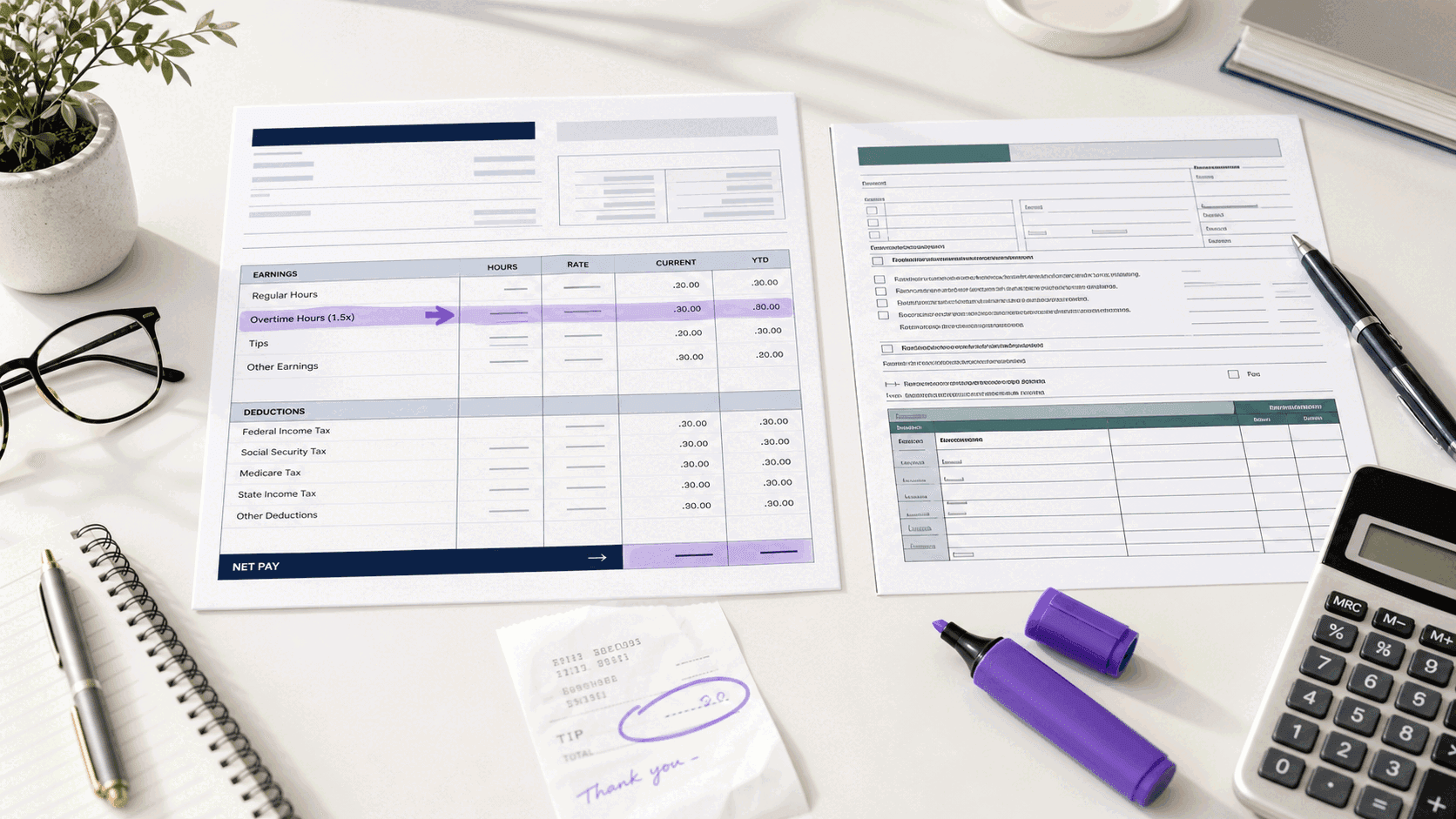
It also changes overtime in a way most hand-made spreadsheets miss. Under federal law the differential is part of your regular rate, so an overtime hour on a night shift is time-and-a-half of base plus differential, not of base alone. This guide puts dollar figures on all of it — per shift, per month, per year — and shows how the differential flows into overtime and into the 2025–2028 "no tax on overtime" deduction.
Who this is for: hourly, non-exempt employees in the US who work evenings, nights or weekends — nurses and other hospital staff, warehouse and distribution workers, security officers, manufacturing crews, call-center agents. What it does not cover: salaried exempt staff (a manager or salaried professional may get a night premium, but has no FLSA overtime for it to flow into), independent contractors, and pay rules outside the US. If you run payroll rather than receive it, the short section near the end is for you.
The sizesWhat a shift differential usually is
A shift differential is extra pay for working the hours an employer finds hard to staff. No federal law requires one for private employers; it comes from a union contract, a company pay policy or an offer letter. It is paid in one of two forms:
- A flat amount per hour — "+$3.00/hour evenings, +$5.00/hour nights". Common in hospital and warehouse pay policies.
- A percentage of the base rate — "+10% for nights". Common in government pay and many union contracts.
There is no national standard size, so here is what published sources actually show — marked by what kind of figure each one is:
VA registered nurses
- Evening
- —
- Night
- 10% (6 pm–6 am); weekend 25%
- What kind of figure
- Federal law
Federal wage-grade (trades) workers
- Evening
- 7.5% (majority of hours 3 pm–midnight)
- Night
- 10% (majority 11 pm–8 am)
- What kind of figure
- Federal law
UW Medicine Northwest nurses (WSNA)
- Evening
- $3.00/h
- Night
- $5.00/h
- What kind of figure
- Union tentative agreement, 2025
| Who | Evening | Night | What kind of figure |
|---|---|---|---|
| VA registered nurses | — | 10% (6 pm–6 am); weekend 25% | Federal law |
| Federal wage-grade (trades) workers | 7.5% (majority of hours 3 pm–midnight) | 10% (majority 11 pm–8 am) | Federal law |
| UW Medicine Northwest nurses (WSNA) | $3.00/h | $5.00/h | Union tentative agreement, 2025 |
Source: CalculatorAI · calculatorai.app · 38 U.S.C. § 7453; 5 U.S.C. § 5343(f); UW Medicine Northwest–WSNA tentative agreement (2025–2027 contract)
Two more BLS figures put those in context. Across all private-industry workers, shift differentials cost employers $0.10 per hour worked in June 2026 — 0.2% of total compensation (BLS Employer Costs for Employee Compensation). That average is tiny because most workers get none: it spreads the pay of the people on nights across everyone on days. Where differentials exist, they concentrate in a few industries — in BLS's pooled 2007–2010 survey data they were 1.2% of gross earnings in healthcare against 0.1% in other service industries (BLS, The Economics Daily).
So the honest summary is a set of reference points, not a national rate: in the published sources above, $3–$5 an hour flat, or 7.5–10% of base for evenings and nights, with weekends sometimes paid separately on top (25% for VA nurses). No public survey we could verify collects private employers' current rates, so the tables below run from $1 an hour up to cover smaller differentials too. Your own figure is in your offer letter, contract or handbook — and on your payslip, usually as its own line.
Per shift, month and yearWhat the differential is worth in dollars
A differential that covers every paid hour of the shift is worth this much for two typical schedules: an hourly worker on five 8-hour nights at $20, and a nurse on three 12-hour nights at $46.90, the BLS median for registered nurses in May 2025 (BLS Occupational Outlook Handbook):
$1.00 an hour
- Per 8-h shift at $20
- $8
- Per year at $20
- $2,080
- Per 12-h shift at $46.90
- $12
- Per year at $46.90
- $1,872
$2.00 an hour
- Per 8-h shift at $20
- $16
- Per year at $20
- $4,160
- Per 12-h shift at $46.90
- $24
- Per year at $46.90
- $3,744
7.5% of base
- Per 8-h shift at $20
- $12
- Per year at $20
- $3,120
- Per 12-h shift at $46.90
- $42
- Per year at $46.90
- $6,585
10% of base
- Per 8-h shift at $20
- $16
- Per year at $20
- $4,160
- Per 12-h shift at $46.90
- $56
- Per year at $46.90
- $8,780
15% of base
- Per 8-h shift at $20
- $24
- Per year at $20
- $6,240
- Per 12-h shift at $46.90
- $84
- Per year at $46.90
- $13,170
$5.00 an hour
- Per 8-h shift at $20
- $40
- Per year at $20
- $10,400
- Per 12-h shift at $46.90
- $60
- Per year at $46.90
- $9,360
| Differential | Per 8-h shift at $20 | Per year at $20 | Per 12-h shift at $46.90 | Per year at $46.90 |
|---|---|---|---|---|
| $1.00 an hour | $8 | $2,080 | $12 | $1,872 |
| $2.00 an hour | $16 | $4,160 | $24 | $3,744 |
| 7.5% of base | $12 | $3,120 | $42 | $6,585 |
| 10% of base | $16 | $4,160 | $56 | $8,780 |
| 15% of base | $24 | $6,240 | $84 | $13,170 |
| $5.00 an hour | $40 | $10,400 | $60 | $9,360 |
Source: CalculatorAI · calculatorai.app · CalculatorAI arithmetic · drafts/shift-differential-pay-numbers.mjs
A $2 night differential at $20 an hour is a 10% raise for the same work, about $347 a month. That is the right way to weigh an offer to move to nights: not "two dollars", but "$4,160 a year, for these hours of my life".
Flat or percentage — which is better?
At the same starting value they pay the same. Over time they do not: a percentage grows with every raise, a flat amount stays where it was until the next contract. At $46.90, 10% is $4.69 an hour — a little less than $5 flat. With 3% annual raises, the base passes $50 in about 2.2 years, and from then on 10% pays more; by year 10 it is worth $11,799 a year against $9,360. If you are comparing two offers, a percentage is worth more the longer you expect to stay.
The nurse's yearHow differentials change a 3×12 night schedule
Three 12-hour nights a week is 156 shifts and 1,872 paid hours a year. Here is the same year at $46.90, with a $5.00 night differential on every hour and a $3.00 weekend differential on every other weekend (two 12-hour weekend nights):
$87,797 of base pay becomes $99,029
156 twelve-hour night shifts at $46.90. The $5 night differential applies to all 1,872 hours; the $3 weekend differential to 624 hours (26 weekends × 24 hours). No overtime, no pickups, no paid time off — the next section adds overtime.
The same nurse on days, with no differentials, earns the base $87,797. That gap — about $11,200 a year — is what nights are worth on this contract. It is also why a hospital rotation from nights to days is, financially, a pay cut, even when the hourly rate on the offer letter does not change.
OvertimeThe differential is part of your regular rate
This is the rule a labor lawyer or payroll specialist would raise first. Under the Fair Labor Standards Act (FLSA), overtime is 1.5 times your regular rate, and the regular rate includes nearly everything you are paid for the hours you work. The Department of Labor's own regulation names shift differentials: the Act "requires the inclusion in the regular rate of such extra premiums as nightshift differentials (whether they take the form of a percent of the base rate or an addition of so many cents per hour)" (29 CFR 778.207(b)). The regular rate is a weekly figure: all straight-time pay for the workweek, differentials included, divided by all hours worked that week.
(hours × base + differential hours × differential) ÷ total hours0.5 × regular rate × hours over 40all straight-time pay + overtime premiumTake the same nurse and add one extra 12-hour night in a week: four nights, 48 hours, 8 hours over 40.
Straight-time pay (48 h)
- Premium on base only
- $2,491.20
- Premium on the regular rate
- $2,491.20
Rate the premium uses
- Premium on base only
- $46.90
- Premium on the regular rate
- $51.90
Overtime premium (8 h × 0.5)
- Premium on base only
- $187.60
- Premium on the regular rate
- $207.60
Each overtime hour pays
- Premium on base only
- $75.35
- Premium on the regular rate
- $77.85
Gross for the week
- Premium on base only
- $2,678.80
- Premium on the regular rate
- $2,698.80
| Line | Premium on base only | Premium on the regular rate |
|---|---|---|
| Straight-time pay (48 h) | $2,491.20 | $2,491.20 |
| Rate the premium uses | $46.90 | $51.90 |
| Overtime premium (8 h × 0.5) | $187.60 | $207.60 |
| Each overtime hour pays | $75.35 | $77.85 |
| Gross for the week | $2,678.80 | $2,698.80 |
Source: CalculatorAI · calculatorai.app · 29 CFR 778.207(b); CalculatorAI arithmetic · drafts/shift-differential-pay-numbers.mjs
Twenty dollars in one week. Pick up an extra night every other week and it is $520 a year — exactly the kind of shortfall that a payslip never shows unless you do the arithmetic, because the overtime line looks plausible either way. A weekend differential in the same week raises the regular rate again (to $53.40 if 24 of the hours also earned $3 weekend pay), so every differential belongs in the calculation, not just the night one.
The hospital option: 8/80
Hospitals and residential care facilities may use a different overtime period under FLSA section 7(j), known as 8/80: overtime after 8 hours in a day or 80 hours in a fixed 14-day period, instead of after 40 in a week. It needs an agreement with the employees before the work is done, and the Labor Department says the same thing about differentials there: employers "must include shift differential pay when determining an employee's regular rate of pay" (DOL Fact Sheet #54).
8/80 matters to 12-hour staff because every 12-hour shift contains 4 hours past 8. Our nurse's ordinary fortnight — six nights, 72 hours — would carry 24 hours of daily overtime, a premium of about $623 every two weeks, or $16,193 a year, without working a single extra shift. That is why units built on 12-hour shifts generally stay on the standard 40-hour workweek, and 8/80 is more common where 8-hour shifts are the norm. If you are on 8/80 and work 12s, your payslip should show it.
The tax angleDifferentials and "no tax on overtime"
From 2025 through 2028, overtime-eligible employees can deduct qualified overtime compensation — up to $12,500 a year ($25,000 on a joint return), reduced above $150,000 of modified adjusted gross income ($300,000 joint). We cover the deduction, the W-4 and the phase-out in no tax on tips and overtime; here is the one part that is specific to shift workers.
The deductible amount is only the premium — the "half" in time-and-a-half — and the IRS computes it from the FLSA regular rate: hours over 40 in the workweek × one-half × the regular rate (IRS FS-2026-13, Q12 and Q15, August 2026). Because the differential raises the regular rate, it raises the deductible premium too.
Gross pay for the year
- Amount
- $120,619
Qualified overtime (W-2 box 12, code TT)
- Amount
- $5,398
Federal income tax saved at 22%
- Amount
- $1,187
Part of that premium due to the differential
- Amount
- $520
Tax saved on that part
- Amount
- $114
| Line | Amount |
|---|---|
| Gross pay for the year | $120,619 |
| Qualified overtime (W-2 box 12, code TT) | $5,398 |
| Federal income tax saved at 22% | $1,187 |
| Part of that premium due to the differential | $520 |
| Tax saved on that part | $114 |
Source: CalculatorAI · calculatorai.app · IRS FS-2026-13; 2026 brackets; CalculatorAI arithmetic · drafts/shift-differential-pay-numbers.mjs
Three things follow from the IRS rules that shift workers should know:
- Only a third of an overtime hour is deductible. Of the $77.85 that overtime night hour pays, $25.95 is premium; the other $51.90 is ordinary straight-time pay, taxed as usual. Social Security and Medicare apply to all of it.
- Premium beyond the FLSA minimum does not count. Double time, a contract's daily overtime or a "premium for every weekend hour" is generous pay, but only the amount "minimally necessary" under the FLSA is qualified (FS-2026-13, Q16). Under 8/80, the premium actually paid under that system is the qualified amount (Q17).
- From 2026, the number on your W-2 decides. You can deduct only what your employer reports in box 12, code TT; if you think it left out the differential, ask for a corrected W-2c — a substitute form will not do (Q20–Q23). This is the second reason to check that the regular rate on your payslips is right.
CaliforniaThe state with daily overtime
Several states add daily overtime on top of the federal weekly rule, and California is the one most shift workers ask about: overtime at 1.5× after 8 hours in a workday or 40 in a workweek, double time after 12 hours in a day, and premium pay on the seventh consecutive day of work. Health-care employers there can adopt — by a secret-ballot vote of the affected employees — an alternative workweek of 12-hour shifts within 40 hours, under which the scheduled 12 hours carry no daily overtime; hours past 12 are double time. California computes overtime on the regular rate as well, so the differential is in it. The tax point is the honest caveat: daily overtime that only state law requires is not qualified overtime for the federal deduction — just the part the FLSA itself would require (FS-2026-13, Q16). Alaska, Nevada and Colorado have their own daily rules; check your state's labor department before assuming the federal picture is the whole one.
Check your payTurn the rules into your own numbers
The arithmetic above is simple for one week and tedious for a year — differentials that cover part of a shift, a weekend that starts at midnight in the middle of a night, a pickup that lands in a different workweek. The free Shift & Hours Tracker does it from your rules:
- 01Describe the job once. Hourly rate, the overtime rules (federal, California, Alaska, Nevada, Colorado, hospital 8/80 or your own thresholds), the day your workweek starts, and your pay period and payday.
- 02Add each differential the way your contract writes it. Night, weekend, holiday or other; a percentage of base or a flat amount per hour; a time window, weekdays or dates. The extra is applied by the minute, so only the part of a shift inside the window earns it, and several differentials stack.
- 03Log shifts or set a rotation. 4-on-4-off, 2-2-3, DuPont, Panama or your own cycle; a 19:00–07:00 night is one row. Overtime is calculated on the blended regular rate, differentials included.
- 04Check the payslip. Type the gross from your payslip and the tracker shows what your logged shifts should have paid — base, differentials, overtime premium — and whether it matches, came in short or over.
The tracker works in gross pay. For take-home after federal and state tax, the Paycheck Tax Calculator does that step, and the Hourly to Salary Calculator turns an effective hourly rate — base plus differentials — into an annual figure for comparing offers. If nights make your paychecks uneven, bills by paycheck shows how to line up due dates so the smaller paycheck still covers what falls before the next one.
If you run payroll
The other side of the same rule: a differential paid but left out of the regular rate is unpaid overtime under the FLSA, owed back to the employee, and — since 2026 — it also understates box 12, code TT on the W-2, which the employer must correct on a W-2c (FS-2026-13, Q11). Build the differential into the weekly regular rate before computing the premium, for every workweek with overtime.
Where these numbers come from
- Base rate: $46.90 an hour, the median pay for registered nurses in the BLS Occupational Outlook Handbook (May 2025 data). The $20 worker is illustrative.
- Differential sizes: VA nurses — 38 U.S.C. § 7453 (night 10% of basic pay for 6 pm–6 am, whole shift when at least four hours fall in that window; weekend 25% from midnight Friday to midnight Sunday). Federal wage-grade workers — 5 U.S.C. § 5343(f) (7.5% and 10%). UW Medicine Northwest — the 2025 tentative agreement with the Washington State Nurses Association for the 2025–2027 contract, published by UW Human Resources (evening $2.50 → $3.00, night $4.50 → $5.00 an hour); a tentative agreement, subject to ratification. Industry averages — BLS Employer Costs for Employee Compensation, June 2026, and BLS The Economics Daily, July 29, 2010.
- Schedules: three 12-hour paid shifts a week × 52 weeks = 1,872 hours; five 8-hour shifts × 52 = 2,080. The night differential covers every paid hour; the weekend differential covers 24 hours every other weekend.
- Overtime: FLSA weekly method, regular rate = straight-time pay ÷ hours worked (29 CFR 778.207(b)); 26 pickup weeks of 48 hours. 8/80: six 12-hour nights per 14 days, 4 hours of daily overtime each, no period overtime on top.
- Tax: qualified overtime per IRS FS-2026-13 (August 2026); 2026 single brackets (22% up to $105,700 of taxable income) and the $16,100 standard deduction; no other income, deductions or pre-tax contributions. State tax ignored.
- Bias: the year assumes no paid time off. Most employers pay vacation and sick hours at base without the differential, so a nurse taking four weeks off earns about 8% less differential than shown. The overtime figures assume the 40-hour week, as most 12-hour units use. All arithmetic is in
drafts/shift-differential-pay-numbers.mjs.
FAQFrequently asked questions
What is a typical night shift differential?
There is no national standard; private employers set their own. Published reference points: federal law sets 10% of base for VA nurses' nights and 7.5% evenings / 10% nights for federal wage-grade workers, and a 2025 Washington nurses' agreement sets $5.00 an hour for nights and $3.00 for evenings.
How much is a $2 night differential worth in a year?
On a full-time 2,080-hour year, $4,160 — $16 per 8-hour shift and about $347 a month. At $20 an hour that is a 10% raise for the same work.
Do shift differentials count toward overtime?
Yes. Under the FLSA, shift differentials are part of the regular rate (29 CFR 778.207(b)), so overtime is 1.5 times base plus differential averaged over the week, not 1.5 times base alone. The same applies under the hospital 8/80 system.
Is a shift differential taxed differently?
No. It is ordinary wages, subject to federal and state income tax, Social Security and Medicare. It only affects the "no tax on overtime" deduction indirectly: it raises the regular rate, and so the overtime premium that can be deducted.
Is a percentage or a flat differential better?
A percentage grows with every raise; a flat amount does not. At $46.90 an hour, 10% pays slightly less than $5 flat today, overtakes it once the base passes $50, and is worth about $2,400 a year more after ten years of 3% raises.
Do salaried employees get shift differentials?
Some do, by employer policy, but exempt salaried employees have no FLSA overtime, so the differential cannot flow into an overtime rate or into the qualified overtime deduction.
Know what your nights are worth
A differential is a raise you earn by when you work, not how. Put it in dollars — per shift, per month, per year — before you trade nights for days or compare two offers. Then check that it reaches your overtime, because the law says it must and your tax deduction depends on it. The free Shift & Hours Tracker prices every hour under your contract's rules and checks the payslip against them.