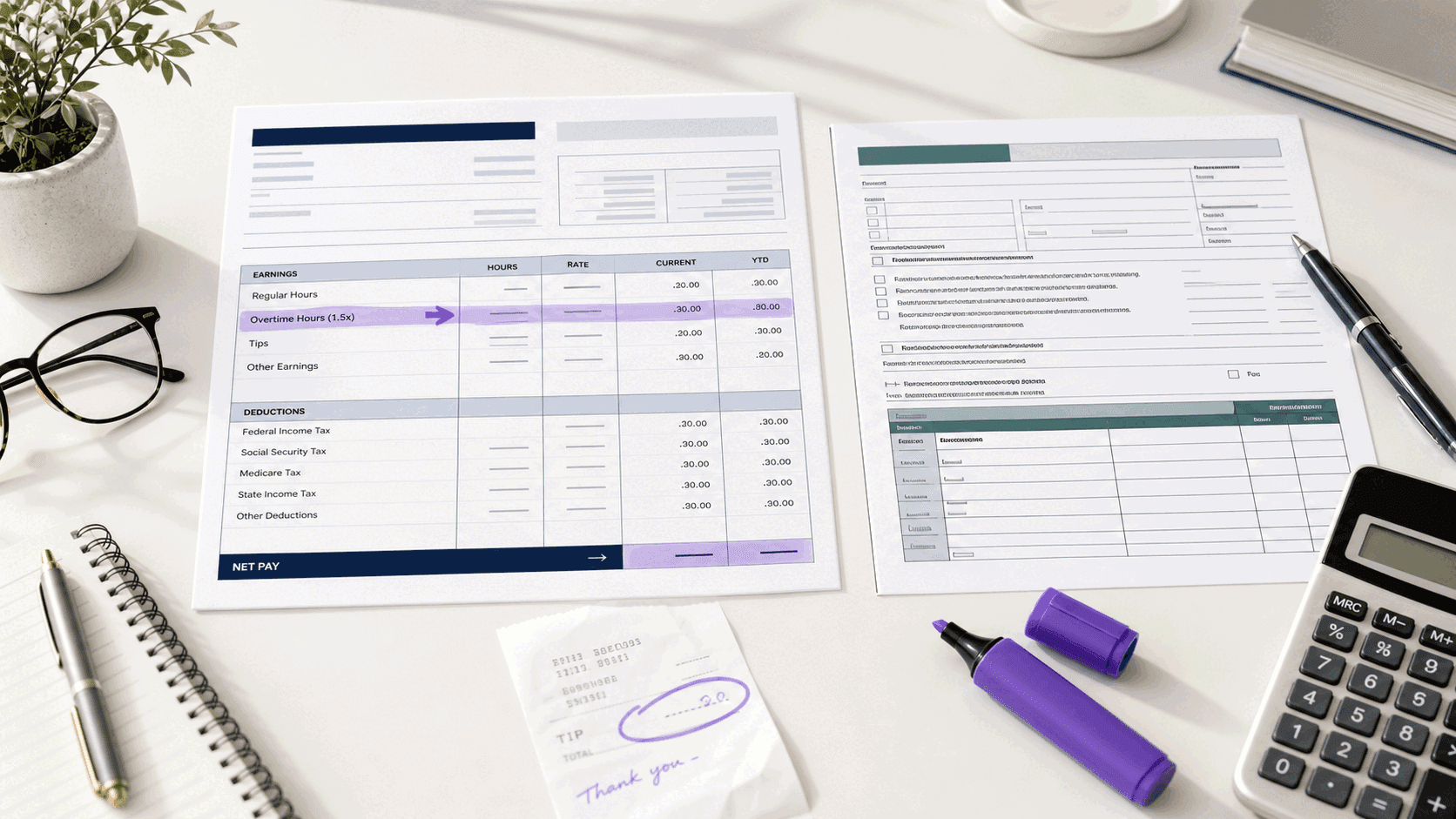
The “7-minute rule” is usually explained as permission to erase seven minutes from a timecard. That is not the federal rule.
Federal regulations let an employer round punches to the nearest five minutes, tenth of an hour or quarter hour only when the practice averages out over time and employees are fully paid for the time they actually work. One to seven minutes may round down under a neutral quarter-hour system; eight to fourteen must round up. A system that always takes early minutes from workers and never gives late minutes back is a different thing.
The money is easy to miss because one shift looks trivial. At $22 an hour, six uncompensated minutes on five shifts a week is $572 a year at straight time. If those minutes sit above 40 hours, they are worth $858 at time-and-a-half.
Who this is for: US hourly, non-exempt workers and small employers checking timecards under the federal Fair Labor Standards Act. What it is not: a conclusion about a particular workplace. State law, union agreements and the facts of what the employee was doing can be more protective.
The ruleSeven down, eight up — but only neutrally
29 CFR 785.48(b) recognizes that employers have historically rounded time when clocks could not practically capture every second. The Department of Labor summarizes quarter-hour rounding this way:
- 1–7 minutes may round down.
- 8–14 minutes must round up.
- Over time, the arrangement must not systematically underpay employees.
Examples around an 8:00 start:
7:53
- Rounded time
- 8:00
- Minutes gained or lost
- 7 lost
7:59
- Rounded time
- 8:00
- Minutes gained or lost
- 1 lost
8:01
- Rounded time
- 8:00
- Minutes gained or lost
- 1 gained
8:07
- Rounded time
- 8:00
- Minutes gained or lost
- 7 gained
8:08
- Rounded time
- 8:15
- Minutes gained or lost
- 7 lost
| Actual punch | Rounded time | Minutes gained or lost |
|---|---|---|
| 7:53 | 8:00 | 7 lost |
| 7:59 | 8:00 | 1 lost |
| 8:01 | 8:00 | 1 gained |
| 8:07 | 8:00 | 7 gained |
| 8:08 | 8:15 | 7 lost |
Source: CalculatorAI · calculatorai.app · 29 CFR 785.48(b) · DOL Fact Sheet 53
The last row looks strange but follows nearest-quarter rounding: 8:08 is closer to 8:15. The same symmetry must exist at both ends and in actual operation. “Always round the start forward and the end backward” is not nearest rounding.
The 2026 clarificationThe system must work both ways
The Wage and Hour Division addressed this exact distinction in Opinion Letter FLSA2026-8. The hospital in the request allowed punches up to seven minutes early but rounded them forward to the scheduled start and prohibited early clock-outs.
The Department said it could not decide the issue merely from punch timing. If workers were only waiting, the lost interval was not necessarily compensable. But if respiratory therapists were receiving required handoff reports after clocking in and before the paid shift, a policy that only rounded those early starts away was not neutral on the stated facts. It benefited the employer without a real opportunity for rounding to benefit employees.
That is the useful test:
- 01Was the employee doing compensable work?
- 02Does the written policy round in both directions?
- 03Does the result actually average out over time?
A policy can look neutral on paper and still fail the third question if schedules, supervisor instructions or the time-clock configuration make losses much more likely than gains.
The annual costTiny minutes become whole shifts
At $22 an hour, five shifts a week for 52 weeks:
2 minutes
- Hours a year
- 8.67
- At straight time
- $191
- At 1.5×
- $286
5 minutes
- Hours a year
- 21.67
- At straight time
- $477
- At 1.5×
- $715
7 minutes
- Hours a year
- 30.33
- At straight time
- $667
- At 1.5×
- $1,001
| Lost each shift | Hours a year | At straight time | At 1.5× |
|---|---|---|---|
| 2 minutes | 8.67 | $191 | $286 |
| 5 minutes | 21.67 | $477 | $715 |
| 7 minutes | 30.33 | $667 | $1,001 |
Source: CalculatorAI · calculatorai.app · CalculatorAI arithmetic · drafts/7-minute-rule-time-clock-rounding-numbers.mjs
Six minutes per shift is 30 minutes a week and 26 hours a year. If someone is scheduled for 40 hours and does those 30 minutes of required work before shifts, the missing half hour is overtime: $22 × 1.5 × 0.5 = $16.50 a week, or $858 a year.
That example assumes every minute is compensable, every week reaches 40 hours, and no rounding gains offset the losses. Change any of those and the total changes. The calculation is a way to measure a pattern, not proof that one exists.
For workers with night or weekend premiums, the regular rate can be higher than base pay. The guide to shift differential pay shows why overtime includes those differentials instead of applying time-and-a-half to base alone.
The auditTest a real timecard in four columns
Keep four values for each shift:
- 01Actual start of compensable work
- 02Actual end of compensable work
- 03Paid start and end
- 04Reason for any difference
Do not begin with a claim. Begin with 30 to 60 shifts and total the signed differences. A neutral system should show gains and losses, with the net moving around zero rather than in one direction every pay period.
Save the source
Keep schedules, punch records, payslips and contemporaneous notes of required pre- or post-shift tasks.
Separate waiting from work
Write what happened during the interval: waiting in the break room is not the same as a required handoff.
Add, do not sample emotionally
Total every gain and loss in the period; a memorable seven-minute loss does not establish the long-run pattern.
Check overtime again
Minutes that push the week beyond 40 are not merely missing straight time; they can change the overtime premium.
The Department of Labor's recordkeeping fact sheet says employers may choose the timekeeping method, but it must be complete and accurate. It also requires daily and weekly hours for covered non-exempt workers and generally calls for payroll records to be preserved for three years, with records supporting wage calculations kept for two.
BreaksDo not let rounding hide a second issue
Time-clock disputes often mix three different questions:
- Rounding: how recorded time is converted.
- Off-the-clock work: required work before clock-in or after clock-out.
- Break treatment: whether a break was paid and whether the employee was fully relieved.
Under the federal baseline, short rest breaks of roughly 5 to 20 minutes are generally paid time. A bona fide meal period, ordinarily 30 minutes or more with the worker completely relieved of duty, can be unpaid. Automatically subtracting 30 minutes when the worker answered calls or could not leave duty is not repaired by a neutral rounding policy.
The Shift Tracker records exact start, end and break minutes and keeps the original rate on a logged shift. Its payslip check compares expected gross pay with the gross on the payslip. It does not declare a legal violation; it gives you a dated arithmetic record to investigate with payroll.
Worker and employerWhat to do with a pattern
For a worker: ask payroll for the rounding policy and your punch record. Show a pay-period table, not a guess. If required tasks are occurring before the paid start, describe the tasks. A supervisor may be able to correct time even when the clock itself rounds.
For an employer: modern systems already record the minute. If rounding has no operational purpose, paying the recorded compensable time is simpler than proving a neutral pattern. Train supervisors not to require setup or handoff before paid time, and audit net rounding by employee and location.
The tax treatment of overtime is a separate issue. The 2025–2028 federal deduction covers the qualifying FLSA premium, not every dollar labelled overtime; what “no tax on overtime” actually means works through that distinction.
Variable shift pay also affects cash planning. The bills-by-paycheck method assigns each bill to the check before its due date rather than trusting a monthly average — useful when nights, overtime or rounding make checks uneven.
Where these numbers come from
- Federal rounding: 29 CFR 785.48(b) and DOL Fact Sheet 53. The regulation permits rounding only when it does not, over time, fail to compensate employees properly.
- 2026 interpretation: WHD Opinion Letter FLSA2026-8. Its conclusion depends on whether compensable work occurred and whether employees actually benefit from rounding in other circumstances.
- Recordkeeping: DOL Fact Sheet 21.
- Worked wage: $22/hour, five shifts a week, 52 weeks. The model multiplies 2, 5 or 7 systematically lost minutes by 260 shifts.
- Overtime column: every lost minute is assumed to fall above 40 hours and be paid at 1.5×. This overstates loss for weeks below 40 and can understate it where a higher regular rate, state daily overtime or double time applies.
- No estimate of prevalence: the examples do not claim that most employers round against workers. They show the value if a timecard audit finds a one-way pattern.
FAQThe 7-minute rule
Can an employer legally round seven minutes off a timecard?
Under the federal rule, a neutral nearest-quarter-hour system may round one to seven minutes down only if eight to fourteen round up and the practice does not systematically underpay workers over time. State law may be stricter.
Does clocking in early mean I must be paid early?
Not by itself. The key question is whether you were performing compensable work or required activities. Waiting for a scheduled shift can be different from receiving a handoff, opening required systems or preparing equipment.
What if the employer always rounds down?
An always-down policy is not neutral nearest rounding. Preserve the actual punches, paid time and description of work performed, then raise the documented pattern with payroll, a union representative, an employment lawyer or the appropriate labor agency.
Do lost minutes count toward overtime?
Yes, if they are compensable hours and push a non-exempt employee beyond the applicable overtime threshold. Under the federal weekly rule, hours over 40 are generally paid at one and one-half times the regular rate.
How many timecards should I check?
Enough to test the “over time” result. One to three pay periods can reveal a configuration problem; a longer sample is stronger where shift timing varies. Include every gain as well as every loss.
The practical answer
Do not argue from the nickname. Compare actual compensable work with paid time, shift by shift, and add both gains and losses. If the result hovers around zero, the system may be doing what neutral rounding is meant to do. If six required minutes disappear five times every week, the small daily number is a 26-hour annual pay problem.