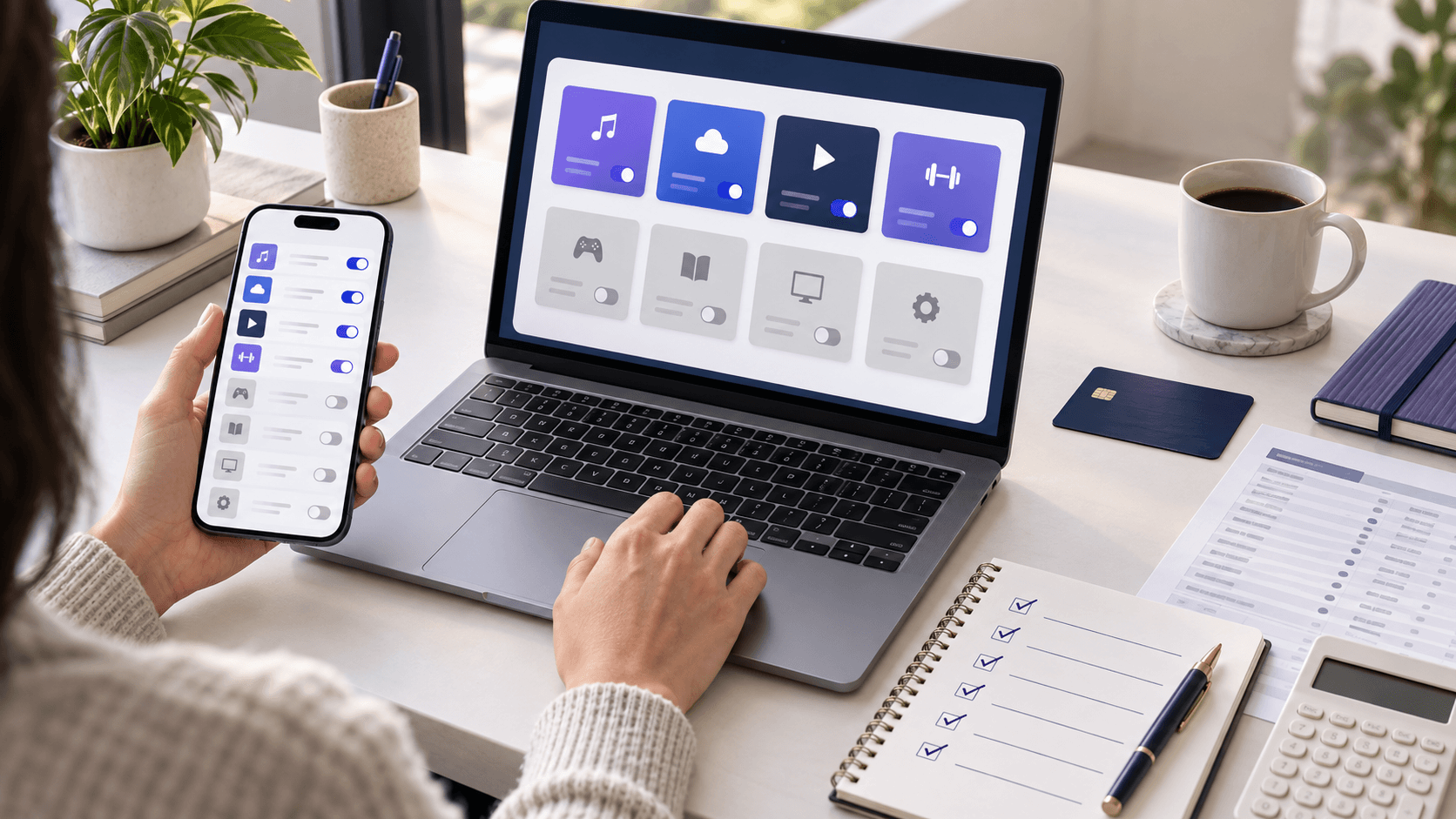
Most subscription bills are never decided. They drift. A streaming service raises its price by $2, a free trial converts on a Tuesday, a storage plan gets bumped up a tier because the phone said it was full, and a second AI assistant joins the first because a colleague swore by it. None of those moments feels like spending money.
Bank of America Institute measured the drift in its own customers' payments: non-utility subscription spending rose 7.7% year over year in July 2026, outpacing total card spending growth by more than a percentage point and a half — the second year running that subscriptions grew faster than everything else.
This guide is about that growth over time — subscription creep — and how to audit it once a year by comparing this year's list with last year's. It is written for US households paying for consumer subscriptions: streaming, apps, cloud storage and AI tools. It does not cover business software seats, utilities or insurance, and it does not walk through cancelling each service step by step; our subscription audit guide does that.
The dataSubscriptions are growing faster than the rest of the budget
The Bank of America Institute report, Consumers subscribe to more spending (September 2, 2026), is built from the bank's aggregated payments data. "Subscriptions" there means non-utility recurring payments: entertainment, retail memberships, reading and AI, home services, fitness, fashion and food.
Subscription spending, year over year
- Figure
- +7.7%
- What it tells you
- Faster than total card spending for two years running
Entertainment and retail share
- Figure
- 43%
- What it tells you
- Streaming, music, games and big-retailer memberships dominate the bill
Reading and information share
- Figure
- 7%
- What it tells you
- The smallest category — and the one that includes AI tools
Reading and information growth, Gen Z
- Figure
- +61%
- What it tells you
- The fastest-growing line, led by younger subscribers
Gen Z total subscription growth
- Figure
- +14%
- What it tells you
- Nearly double the overall rate
| Measure | Figure | What it tells you |
|---|---|---|
| Subscription spending, year over year | +7.7% | Faster than total card spending for two years running |
| Entertainment and retail share | 43% | Streaming, music, games and big-retailer memberships dominate the bill |
| Reading and information share | 7% | The smallest category — and the one that includes AI tools |
| Reading and information growth, Gen Z | +61% | The fastest-growing line, led by younger subscribers |
| Gen Z total subscription growth | +14% | Nearly double the overall rate |
Source: CalculatorAI · calculatorai.app · Bank of America Institute, Consumers subscribe to more spending (September 2, 2026)
Two caveats keep these figures honest. They describe Bank of America customers, and the bank itself notes its data "may reflect a degree of selection bias." And 7.7% is the growth of spending, which mixes higher prices with more subscriptions — the report does not separate the two. Your own audit can, and that split is the whole point of this guide.
Three kinds of creepWhy the bill grows without a decision
Every increase in a subscription bill falls into one of three buckets, and each one needs a different fix:
- Price creep. The provider raises the price of a plan you already have. You did nothing; the bill went up anyway. The fix is a yearly price check and, sometimes, a cheaper tier, an annual plan or a rotation.
- Tier creep. You move up a level — 200 GB of storage to 2 TB, an ad-supported plan to ad-free, a solo plan to a family plan. It was a decision, but a tiny one, usually made in the moment and never revisited.
- Count creep. A new subscription joins the list: a trial that converted, a tool bought for one project, a second service that does the job of the first. This is the biggest bucket for most people, and in 2026 it is increasingly an AI tool.
Separating them matters because "my subscriptions went up" is not actionable. "Providers added $72 a year and I added $480 a year" is.
A worked yearOne household, October 2025 vs October 2026
Here is an illustrative household — not an average, just a realistic shape. The price moves are real 2026 US changes; the plan choices are invented.
Disney+/Hulu Premium bundle
- Oct 2025
- $19.99
- Oct 2026
- $21.99
- Kind of creep
- Price
Peacock Premium
- Oct 2025
- $10.99
- Oct 2026
- $12.99
- Kind of creep
- Price
Apple TV
- Oct 2025
- $12.99
- Oct 2026
- $14.99
- Kind of creep
- Price
ChatGPT Plus
- Oct 2025
- $20.00
- Oct 2026
- $20.00
- Kind of creep
- None
iCloud+ (200 GB → 2 TB)
- Oct 2025
- $2.99
- Oct 2026
- $9.99
- Kind of creep
- Tier
Fitness app (unused since March)
- Oct 2025
- $14.99
- Oct 2026
- $14.99
- Kind of creep
- None — but idle
Claude Pro
- Oct 2025
- —
- Oct 2026
- $20.00
- Kind of creep
- Count
Google AI Pro (trial converted)
- Oct 2025
- —
- Oct 2026
- $19.99
- Kind of creep
- Count
Total per month
- Oct 2025
- $81.95
- Oct 2026
- $134.94
- Kind of creep
- +$52.99
| Subscription | Oct 2025 | Oct 2026 | Kind of creep |
|---|---|---|---|
| Disney+/Hulu Premium bundle | $19.99 | $21.99 | Price |
| Peacock Premium | $10.99 | $12.99 | Price |
| Apple TV | $12.99 | $14.99 | Price |
| ChatGPT Plus | $20.00 | $20.00 | None |
| iCloud+ (200 GB → 2 TB) | $2.99 | $9.99 | Tier |
| Fitness app (unused since March) | $14.99 | $14.99 | None — but idle |
| Claude Pro | — | $20.00 | Count |
| Google AI Pro (trial converted) | — | $19.99 | Count |
| Total per month | $81.95 | $134.94 | +$52.99 |
Source: CalculatorAI · calculatorai.app · drafts/subscription-creep-audit-numbers.mjs
The household's bill went from $983.40 to $1,619.28 a year — up $635.88, or 65%. Nobody in it would say they decided to spend $636 more on subscriptions.
Most of the creep was the household's own doing
Price increases alone added 7.3% to last year's bill — strikingly close to the 7.7% growth Bank of America measured across all subscriptions. But two new AI plans added 48.8%, and one storage upgrade added another 8.5%.
That split is the most useful thing an audit can produce. The streaming headlines get the attention, but in this household they explain about one dollar in nine of the increase.
Price creepThe 2026 streaming increases, in one number
Streaming is where price creep is easiest to see. This fall, Disney+, Hulu, Peacock, Apple TV and ESPN all raised US prices within about five weeks. Disney+ Premium and Hulu Premium each went from $18.99 to $21.49; Peacock Premium from $10.99 to $12.99; Apple TV from $12.99 to $14.99. We added them up in the Disney+ and Hulu price increase guide: a five-service ad-free stack rose $120 a year between July and October.
For scale, consumer prices overall rose 3.7% in the year to September, according to the Bureau of Labor Statistics. The three increases in our example household added 7.3% to its subscription bill — roughly double general inflation, on services whose plans did not change.
Price creep is also the kind you can partly undo without losing anything:
- Bundle what you already pay for separately. The Disney+/Hulu Premium bundle costs 50 cents more than Disney+ Premium alone.
- Pay yearly only for the certain ones. Claude Pro is $20 monthly or $200 a year — $40 cheaper, but only if you would have kept all twelve months.
- Rotate the occasional services. Cancelling a streaming service usually keeps your profile and history. Four months on, eight months off cuts its cost by two-thirds.
AI creepThe newest line on the list
The Bank of America report singles out "reading and information" — the category that includes AI offerings — as the fastest-growing subscription type, up more than 60% a year among Gen Z and 51% among younger Millennials.
AI tools creep in a particular way. The general assistants all sit at the same price point, so adding a second or third one feels like adding "just another $20":
ChatGPT Plus
- Monthly
- $20.00
- Per year
- $240.00
Claude Pro (monthly)
- Monthly
- $20.00
- Per year
- $240.00
Claude Pro (annual plan)
- Monthly
- $16.67
- Per year
- $200.00
Google AI Pro
- Monthly
- $19.99
- Per year
- $239.88
Cursor Premium
- Monthly
- $30.00
- Per year
- $360.00
ChatGPT Plus + Claude Pro + Google AI Pro
- Monthly
- $59.99
- Per year
- $719.88
| Plan | Monthly | Per year |
|---|---|---|
| ChatGPT Plus | $20.00 | $240.00 |
| Claude Pro (monthly) | $20.00 | $240.00 |
| Claude Pro (annual plan) | $16.67 | $200.00 |
| Google AI Pro | $19.99 | $239.88 |
| Cursor Premium | $30.00 | $360.00 |
| ChatGPT Plus + Claude Pro + Google AI Pro | $59.99 | $719.88 |
Source: CalculatorAI · calculatorai.app · OpenAI · Anthropic · Google · Cursor
Three general assistants at once is $719.88 a year. Sometimes that is justified — different tools are genuinely better at different work, as our ChatGPT vs Claude vs Gemini cost comparison shows. Often it is an overlap nobody priced, especially when one of them arrived bundled with a phone or as a free trial.
The test for an AI subscription is the same as for streaming, with one twist: ask which job each one owns. "Coding" and "writing" can justify two tools; "asking questions" cannot justify three. Higher tiers are their own form of tier creep — ChatGPT Pro and Claude Max start at $100 a month, and stepping up is one click.
The creep auditSix steps, once a year
A regular subscription audit asks "what am I paying for?" A creep audit asks a sharper question: "what changed since last year, and did I choose it?" That needs last year's list, which is why the first audit is the hardest and every one after it takes minutes.
Write this year's list
Every recurring charge with its current price and billing cycle — from card statements, the App Store and Google Play subscription screens, PayPal automatic payments and email receipts.
Put last year's beside it
Use last year's audit, a saved tracker list or the same month's card statements from a year ago. Match each service to its old price.
Label every difference
Mark each change as price (the provider raised it), tier (you upgraded) or count (it is new). Unchanged lines get no label.
Annualize each bucket
Multiply each monthly difference by twelve. A yearly figure per bucket shows where the growth actually came from.
Decide bucket by bucket
Count creep: keep only what you would buy again today. Tier creep: ask whether the higher tier is used. Price creep: bundle, switch billing or rotate.
Save the list for next year
This year's final list becomes next year's baseline. Without it, the next audit starts from zero.
The repurchase question does most of the work at step 5: would I sign up today, at this year's annual price, knowing how much I actually used it? An unused $14.99 fitness app has cost $119.92 since March; a converted trial nobody chose fails the question on day one.
The resultWhat the audit saved our household
Applying those decisions to the example household:
- Cancel the converted Google AI Pro trial and the unused fitness app. Saves $419.76 a year.
- Rotate Peacock and Apple TV — four months each instead of twelve. Saves $223.84.
- Switch Claude Pro to the annual plan, since it now does daily work. Saves $40.
Below last year's bill, with both AI tools kept
The household keeps ChatGPT Plus and Claude Pro, the larger iCloud plan and every streaming service for at least part of the year. It cancels two charges nobody was using and stops paying for two services in the months it does not watch them.
The audit did not undo the price increases — nobody can. It undid the creep that was the household's own: the trial, the idle app and paying all year for services watched a third of the time.
Keep it from creeping backMake next year's audit a five-minute job
Creep comes back because the moments that cause it — a price email, a trial signup, an upgrade prompt — happen months apart and never land in one place. Put them in one list:
Record prices when they change
In the Subscription Tracker, editing a price saves the change from → to with its yearly effect, so this year's increases appear in one "Prices that changed" list.
Log every trial on day one
Mark it as a trial with the end date. The overview lists trials about to convert, and a reminder fires before the first charge.
Rate what you pay for
Score each service from 1 to 5. Anything rated "should cancel" that is still charging shows up with its yearly cost.
Let overlaps surface
Services in the same category — three AI assistants, two storage plans — are grouped so the duplicate is visible.
Set a monthly cap
A cap for the subscriptions category turns the next signup into a decision instead of a default.
Keep the cancel link
Save each service's cancellation page next to it, so rotating a streaming plan takes one tap instead of a search.
The Subscription Tracker does not connect to your bank or cancel anything for you — you add plans manually, import a CSV or pull recurring lines from the Expenses Tracker. That is also why it works as a creep record: each line is a decision you made, with a date and a price. For a one-off total without an account, the Subscription Audit Calculator annualizes a list in one screen, and the $2,000 subscription blind spot explains the five leaks — trials, duplicates, price rises, 28-day billing and family plans — in more detail.
Frequently asked questions
What is subscription creep?
It is the slow growth of what you pay for recurring services without a deliberate decision to spend more. It comes from three sources: providers raising prices, you moving to higher tiers, and new subscriptions — often trials or AI tools — joining the list.
How fast is subscription spending growing in 2026?
Bank of America Institute reported non-utility subscription spending up 7.7% year over year in July 2026, faster than total card spending for the second year running. Spending on reading and information subscriptions, which include AI offerings, grew more than 60% among Gen Z customers.
How is a creep audit different from a normal subscription audit?
A normal audit looks at what you pay today. A creep audit compares today's list with last year's and labels every difference as price, tier or count. That shows whether your bill grew because of providers or because of your own additions, which decides what to fix.
Should I cancel AI subscriptions to save money?
Not by default. An AI tool used for daily work can be good value at $240 a year. The common waste is overlap — two or three general assistants doing the same job — and trials that converted without a decision. Keep the ones that own a distinct job.
Is paying annually a good way to beat price increases?
Only for services you are certain to keep. Claude Pro's annual plan saves $40 against twelve monthly payments, but annual plans also renew silently once a year and are easy to forget. Use them for the tools you use daily, and monthly billing for anything you might rotate.
Where these numbers come from
- Subscription spending trends: Bank of America Institute, Consumers subscribe to more spending, September 2, 2026 — growth of 7.7%, category shares, and generational growth rates, all from Bank of America's aggregated payments data, which the bank notes is not comprehensive.
- Streaming prices and 2026 increases: as compiled, with dates and press sources, in our Disney+ and Hulu price increase guide.
- AI plan prices: Anthropic's Claude pricing page (Pro $20 monthly or $200 a year; Max from $100) and Cursor's pricing page (individual plans $8–$200, Premium $30) were checked October 29, 2026. ChatGPT Plus ($20) and Google AI Pro ($19.99) are the US list prices on OpenAI's and Google's plan pages; prices outside the US differ.
- Storage: iCloud+ US prices as listed by Apple — 200 GB $2.99, 2 TB $9.99.
- Inflation: the Bureau of Labor Statistics Consumer Price Index, 3.7% for the 12 months to September 2026.
- All household arithmetic — the three buckets, the AI total and the audit savings — is in
drafts/subscription-creep-audit-numbers.mjs. The household is illustrative: plan choices are invented, prices are pre-tax list prices without promotions or student discounts, and rotation assumes you would genuinely not watch in the months off. Those assumptions make the savings an upper bound for households that watch every service year-round.