A dividend portfolio is the rare investment that pays you without you selling anything. That is the whole appeal: the shares stay yours, and cash arrives anyway — quarterly for most US companies, monthly for a handful, twice a year across much of Europe.
It is also the corner of investing where the numbers most easily flatter you. A high yield is often a warning. A dividend that has been raised for twenty years can still be cut. And the figure everyone quotes — current yield — tells you almost nothing about what your own holding is doing for you.
Here is how the income actually works, what to check before buying for yield, and how to keep track of it without a spreadsheet you eventually abandon.
Two yieldsThe two yields, and why only one of them is about you
Current yield is the annual dividend divided by today's share price. It describes the stock, not your position. Everyone who looks it up sees the same number.
Yield on cost is the same dividend divided by what you paid. It is the one that answers "what is this position doing for me".
Buy at $40 a share with a $1.60 annual dividend and both read 4%. Ten years later the dividend has grown to $3.20 and the price to $80: the current yield still reads 4%, while your yield on cost is 8%. Nothing about the company changed between those two numbers — only whose money is being measured.
That gap is the entire argument for holding a growing dividend instead of chasing the highest number on a screener. A payout that rises every year is a portfolio's version of the annual Social Security COLA. It is also why a portfolio bought years ago can quietly out-earn a fresh one with a much better-looking yield.
Four datesThe four dates, only one of which has a deadline
Every dividend has four dates, and three of them are trivia:
- Declaration date — the company announces it.
- Ex-dividend date — the cut-off. Own the share before this date or the payment goes to whoever sold it to you.
- Record date — the company checks its books.
- Pay date — the money lands, usually two to four weeks after the ex-date.
Only the ex-date can cost you anything by being missed. Buying "before the dividend" a day too late is one of the most common beginner mistakes, and it is invisible until a payment simply does not arrive.
SafetyWhat makes a dividend safe
There is no score worth trusting here, but there are three public signals that mean something.
Payout ratio. The share of profit being paid out. Comfortably under 60% leaves room for a bad year; over 100% means the company is paying out more than it earns, which it can do for a while and not forever.
The exception matters: REITs and funds are required to distribute most of their income, so a 90% payout ratio there is the business model, not a red flag. Applying the same rule to both is how people talk themselves out of perfectly sound holdings.
A streak of increases. Twenty years of annual raises tells you management treats the dividend as a promise. It is not a guarantee — plenty of long streaks have ended — but it is the closest thing to a stated intention.
Any cut, ever. A dividend that was reduced once will be reduced again more easily than one that never has. The last cut is the single most useful fact in the history.
And one signal that is usually a trap: an unusually high yield. Yield rises when the price falls. A 12% yield is the market saying it does not believe the dividend will survive, and quite often the market is right. The exception is a fund that manufactures its yield by selling options — JEPI vs JEPQ shows what an 8–11% distribution is made of and what it gives up.
Empty monthsThe empty-month problem
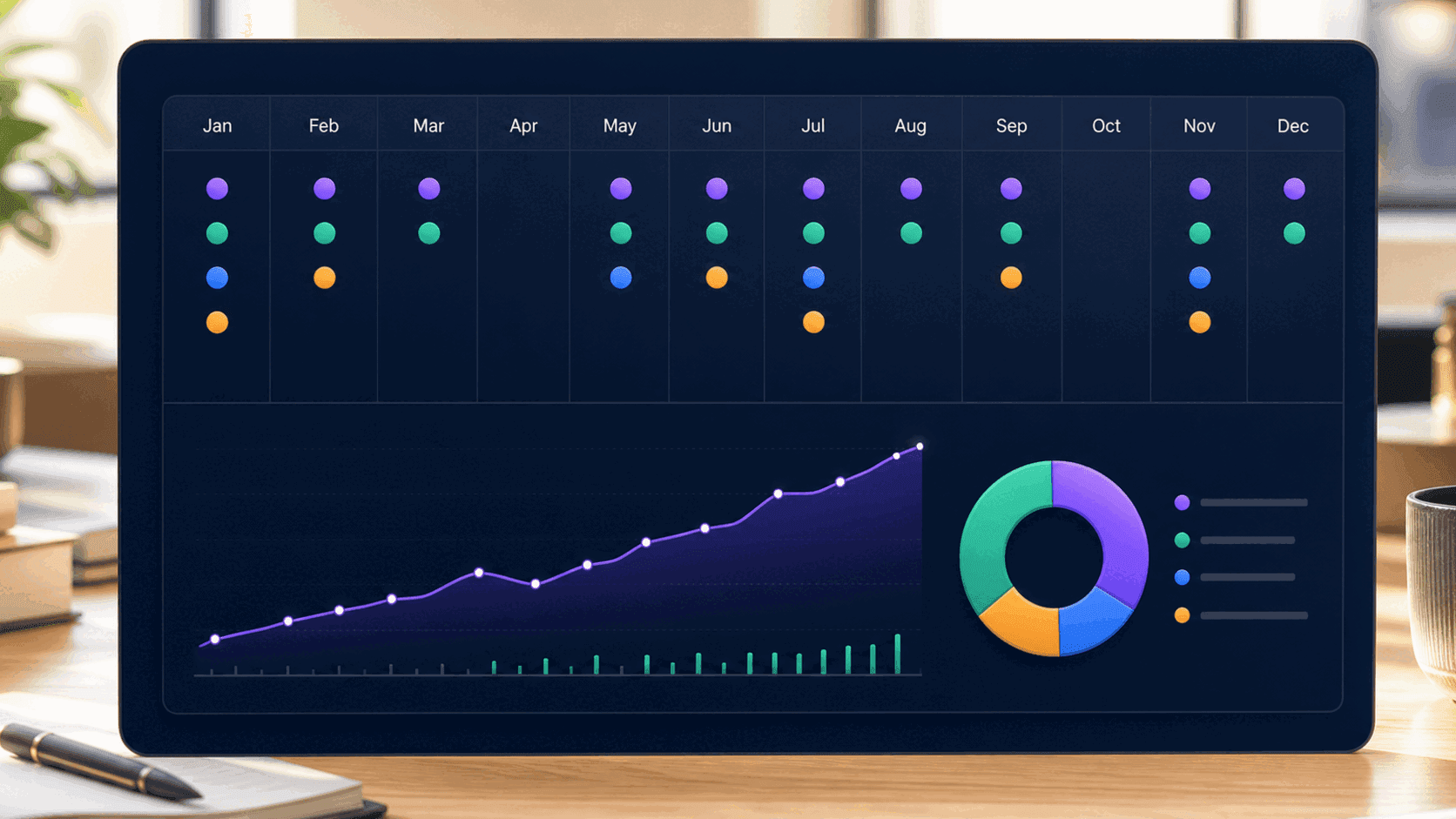
Most US companies pay in one of three quarterly cycles: January/April/July/October, February/May/August/November, or March/June/September/December. A dividend calendar shows what that does to monthly income: the same $3,240 a year can arrive as four lumps or as $270 every month.
Buy four holdings without thinking about it and there is a good chance they all sit on the same cycle — which means eight months of the year bring nothing at all. The fix is not more holdings, it is holdings on a different cycle. This is the one piece of dividend planning nobody does with a spreadsheet, because a spreadsheet shows you what you own, not the months you have left empty.
ReinvestmentReinvestment: where the compounding actually comes from
Reinvesting a dividend buys more shares, which pay more dividends, which buy more shares. That loop, plus dividend growth, is what turns a modest yield into a meaningful income over a decade or two.
The maths is unremarkable and the discipline is not:
- Reinvest during the years you do not need the income. Switching to cash later is a decision you can make in a minute; the compounding you skipped cannot be recovered.
- Contributions dominate early, growth dominates late. For the first several years, what you add matters far more than what compounds. (An eighteen-year version of the same point: in a Trump Account the family's monthly habit ends up as 90% of the balance and the government's $1,000 seed as the rest.) After a decade or so, that reverses.
- Model tax, not just the gross dividend. A projection that ignores withholding overstates the result quietly and by a lot.
The DRIP Calculator runs that loop with your own numbers, and the Target Income Calculator answers the reverse question: how much capital a given monthly income requires at the yield you actually hold, rather than at a round number.
TaxTax, briefly and honestly
Two things get taxed, in two different places.
Withholding at the source. A foreign company's home country generally takes a cut before the money leaves — commonly 15% for US shares under a treaty, 25–35% elsewhere, and 0% in a few places. Rates vary by country pair and by what paperwork your broker holds.
Your own income tax, on top, wherever you live. In the US, "qualified" dividends are taxed at long-term capital gains rates if you held the shares long enough; ordinary dividends and most REIT distributions are taxed as ordinary income.
The practical version: a portfolio spread across several countries has a real gap between the dividend announced and the money that arrives, and it is not a rounding error. Model the net or the plan is fiction.
Capital requiredHow much capital for $1,000 a month?
$12,000 a year at a 4% yield needs $300,000. At 3%, $400,000. At 6% — if you believe the 6% — $200,000.
That arithmetic is the most useful sanity check in dividend investing, and the reason the honest advice is usually "keep adding" rather than "find a better yield". Reaching for two extra points of yield changes the required capital by a third; reaching for it in the wrong holding can cost you the dividend entirely.
TrackingKeeping track without a spreadsheet you abandon
The information you need is not complicated, it is just spread out: what each holding pays, when the next ex-date is, what actually landed, and what it becomes if you keep reinvesting.
That is what the Dividend Tracker is built around — a twelve-month calendar rather than a list of tickers, with dividend amounts and ex-dates filled in from the ticker, withholding modelled per holding, and a payment log shared with the Portfolio Tracker so one entry counts in both places.
The habit that makes any of it work is smaller than the tooling: log what actually arrived. Estimates drift, companies change their schedules, and a year of real payments is the only record that tells you what your income truly is.
FAQFrequently asked questions
How often are dividends paid? Most US companies pay quarterly. Some pay monthly — often REITs and certain funds — and much of Europe pays once or twice a year.
Is a high dividend yield good? Not by itself. Yield goes up when the price goes down, so the highest yields on any screener are often companies whose dividend the market expects to be cut.
What is a good payout ratio? Under about 60% for an ordinary company leaves room to keep paying through a bad year. For REITs and funds the ratio is meaningless as a warning, since they are required to distribute most of their income.
Should I reinvest dividends or take the cash? Reinvest while you do not need the income — that loop is where the compounding comes from. Take the cash once the income is the point, which is a decision you can change at any time.
Do I pay tax on dividends I reinvest? Yes. Reinvesting is a purchase made with money you were paid; the tax treatment is the same as if you had taken the cash.
What happens if I buy the day before the pay date? Nothing. The deadline is the ex-dividend date, which comes weeks earlier. Buying after it means the previous owner receives this payment.
How do I know what I will actually receive from a foreign holding? Take the gross dividend, subtract the payer country's withholding rate, then apply your own income tax. Your broker's tax documents are the authority on what was withheld.
Next stepStart with one holding
Add a single dividend-paying position with what you paid and what it pays, and the calendar already tells you something: which month is thin, what the yield on cost is against your actual cost, and what the payment looks like after the payer's country takes its share. Everything else in dividend investing is that same exercise, repeated and kept current.
Nothing here is investment advice, and no projection is a promise: companies cut dividends, and a plan that assumes they never do is not a plan.