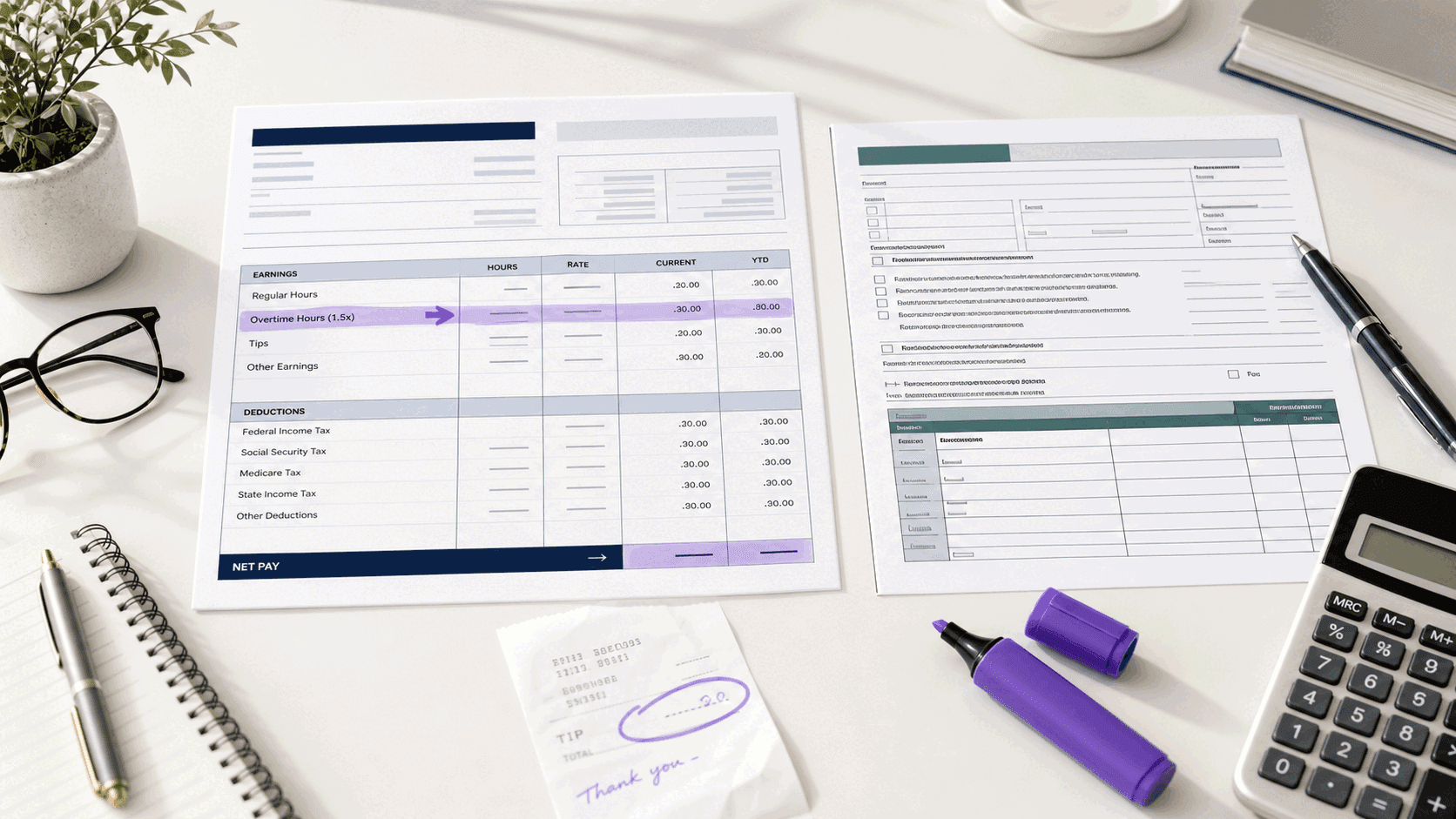
Short answer: a bonus is taxed as ordinary wages, at the same rates as your salary. What makes it feel different is the withholding. Most employers take a flat 22% for federal income tax, plus 7.65% for Social Security and Medicare, plus state tax. That can be well over 30% of the check. But 22% is a prepayment, not the final tax. When you file, the bonus is added to the rest of your income, and depending on your bracket you get part of it back or owe a little more.
Who this is for: US employees getting a year-end, holiday, signing or performance bonus in 2026, and the small-business owners and payroll staff who pay one. What it does not cover: stock options and RSUs (they follow their own rules), bonuses paid to contractors on a 1099 (no withholding at all), and local income taxes outside New York City. Every rate below was checked against the IRS, the Social Security Administration or the state's own revenue agency on November 16, 2026.
Federal withholdingThe 22% flat method and the aggregate method
The IRS calls bonuses supplemental wages, along with commissions, severance, back pay and awards (IRS Publication 15 (2026), section 7). How your employer withholds on one depends on how it is paid:
- Paid together with your salary and not listed separately. The employer treats the total as one normal paycheck and runs it through the regular withholding tables.
- Listed or paid separately. If the employer withheld income tax from your regular wages this year or last year, it can choose between two methods. One is a flat 22%, and the IRS says no other percentage is allowed. The other is the aggregate method: add the bonus to your most recent regular paycheck, figure withholding on the total as if it were one paycheck, subtract what was already withheld from the paycheck, and withhold the rest from the bonus.
- More than $1 million of supplemental wages in a calendar year. Everything above $1 million is withheld at a mandatory 37%, whatever your W-4 says. A $1.5 million bonus has $220,000 withheld on the first million and $185,000 on the rest, $405,000 in total.
Both rates stay in place because the 2025 tax law (P.L. 119-21) made the current income tax rates permanent.
The two methods can give very different results on the same bonus. Publication 15 has its own example:
A $1,000 bonus on a $2,000 monthly salary
A single employee earns $2,000 a month, and $65 is withheld from each paycheck. She gets a $1,000 bonus on May 15. With the aggregate method, the employer figures withholding on $3,000 as one paycheck ($179) and subtracts the $65 already withheld. With the flat method, it takes 22% of $1,000.
On a large bonus the aggregate method can withhold more than 22%, because the tables treat that one big paycheck as if you earned it every pay period. Neither method changes the tax you finally owe.
FICASocial Security and Medicare on a bonus
A bonus is subject to the same payroll taxes as salary, whichever withholding method is used:
- Social Security: 6.2% on wages up to the 2026 wage base of $184,500 (SSA; IRS Publication 15). Once your wages for the year pass that amount, no more is withheld.
- Medicare: 1.45% on every dollar, with no limit.
- Additional Medicare tax: 0.9% on wages above $200,000 in the year. Your employer starts withholding it in the pay period your wages pass $200,000, and pays no matching share.
That 7.65% (6.2% + 1.45%) is a real tax. Unlike most of the 22%, it does not come back when you file. If you have earned close to the wage base, it is smaller. On a $180,000 salary, a $20,000 bonus pays Social Security on only the first $4,500, so FICA is $569 instead of $1,530.
State taxSupplemental rates in notable states
Most states with an income tax have their own rules for bonuses. Some use a separate flat rate, and some apply their regular rate. Nine states have no income tax on wages at all: Alaska, Florida, Nevada, New Hampshire, South Dakota, Tennessee, Texas, Washington and Wyoming.
New York
- Rate on bonuses
- 11.70%
- On a $5,000 bonus
- $585
- Note
- Plus 4.25% in New York City ($212.50)
California
- Rate on bonuses
- 10.23%
- On a $5,000 bonus
- $511.50
- Note
- Bonuses and stock options; 6.6% for other supplemental pay; SDI 1.3% on top
Georgia
- Rate on bonuses
- 4.99%
- On a $5,000 bonus
- $249.50
- Note
- Rate in effect when paid; 5.19% before May 11, 2026
Illinois
- Rate on bonuses
- 4.95%
- On a $5,000 bonus
- $247.50
- Note
- Flat rate on all wages
North Carolina
- Rate on bonuses
- 4.09%
- On a $5,000 bonus
- $204.50
- Note
- Flat supplemental option
Pennsylvania
- Rate on bonuses
- 3.07%
- On a $5,000 bonus
- $153.50
- Note
- Flat rate on all wages; local earned income tax extra
No income tax (9 states)
- Rate on bonuses
- 0%
- On a $5,000 bonus
- $0
- Note
- Federal tax and FICA still apply
| State | Rate on bonuses | On a $5,000 bonus | Note |
|---|---|---|---|
| New York | 11.70% | $585 | Plus 4.25% in New York City ($212.50) |
| California | 10.23% | $511.50 | Bonuses and stock options; 6.6% for other supplemental pay; SDI 1.3% on top |
| Georgia | 4.99% | $249.50 | Rate in effect when paid; 5.19% before May 11, 2026 |
| Illinois | 4.95% | $247.50 | Flat rate on all wages |
| North Carolina | 4.09% | $204.50 | Flat supplemental option |
| Pennsylvania | 3.07% | $153.50 | Flat rate on all wages; local earned income tax extra |
| No income tax (9 states) | 0% | $0 | Federal tax and FICA still apply |
Source: CalculatorAI · calculatorai.app · CA EDD DE 44 (2026); NYS-50-T-NYS and NYS-50-T-NYC (1/26); Georgia DOR Employer's Tax Guide 2026 (Sept. 2026); NC-30 (2026); Illinois IL-700-T (2026); Pennsylvania DOR · arithmetic in drafts/how-are-bonuses-taxed-2026-numbers.mjs
Sources: California EDD, 2026 Employer's Guide; New York NYS-50-T-NYS; Georgia DOR 2026 guide; NC-30 (2026); Illinois IL-700-T; Pennsylvania employer withholding.
California's 10.23% is more than most middle earners really owe, so they get part of it back on their state return.
Worked examplesA $5,000 and a $20,000 bonus, single filer
Both examples use 2026 federal figures for a single filer: the $16,100 standard deduction and brackets of 10% up to $12,400 of taxable income, 12% to $50,400, 22% to $105,700 and 24% to $201,775 (IRS Rev. Proc. 2025-32). The bonus is the only extra income, the employer uses the flat 22%, and the employee lives in a state with no income tax.
$5,000 bonus on a $60,000 salary
Taxable income goes from $43,900 to $48,900, still inside the 12% bracket. The flat 22% takes $1,100, but the real extra federal tax is 12% × $5,000 = $600. FICA takes $382.50. The $500 difference comes back as a bigger refund, or a smaller bill, when you file.
$20,000 bonus on a $120,000 salary
Taxable income goes from $103,900 to $123,900. The first $1,800 is taxed at 22% and the other $18,200 at 24%, for $4,764 of real federal tax. The flat 22% withheld only $4,400, so $364 is still owed when you file. FICA is $1,530 because $140,000 is still under the Social Security wage base.
So the same 22% is too much for one person and too little for the other. To run your own salary, bonus, state and withholding method, use the Bonus Tax Calculator. To see a regular paycheck the same way, use the Paycheck Tax Calculator.
At filingWhy the withheld amount is not your final tax
On your W-2, the bonus is simply part of Box 1 wages. The tax return does not know it was a bonus. Your total tax is figured on all your income, and everything withheld during the year, from salary and bonus, is subtracted from it. Here is how the flat 22% compares with what $1,000 of bonus really costs in each 2026 bracket:
10%
- Taxable income (single)
- Up to $12,400
- Real tax
- $100
- At filing
- $120 back
12%
- Taxable income (single)
- $12,400–$50,400
- Real tax
- $120
- At filing
- $100 back
22%
- Taxable income (single)
- $50,400–$105,700
- Real tax
- $220
- At filing
- Even
24%
- Taxable income (single)
- $105,700–$201,775
- Real tax
- $240
- At filing
- $20 owed
32%
- Taxable income (single)
- $201,775–$256,225
- Real tax
- $320
- At filing
- $100 owed
35%
- Taxable income (single)
- $256,225–$640,600
- Real tax
- $350
- At filing
- $130 owed
| Your top bracket | Taxable income (single) | Real tax | At filing |
|---|---|---|---|
| 10% | Up to $12,400 | $100 | $120 back |
| 12% | $12,400–$50,400 | $120 | $100 back |
| 22% | $50,400–$105,700 | $220 | Even |
| 24% | $105,700–$201,775 | $240 | $20 owed |
| 32% | $201,775–$256,225 | $320 | $100 owed |
| 35% | $256,225–$640,600 | $350 | $130 owed |
Source: CalculatorAI · calculatorai.app · IRS Rev. Proc. 2025-32; IRS Publication 15 (2026)
If you are in the 32% or 35% bracket and get a big bonus, the shortfall adds up: $100,000 at 35% is $13,000 more than the 22% withheld. You can cover it by raising withholding on your remaining paychecks with a new W-4 (an extra amount on line 4(c)), or with an estimated payment. Our guide to quarterly estimated taxes explains the deadlines. To estimate the refund or balance due for the whole year, try the Tax Refund Calculator.
Lower the taxThree ways that work, and one that doesn't
- Defer part of the bonus into your 401(k). Many plans let your deferral percentage apply to bonuses, and some let you set a separate election for them. A pre-tax deferral skips federal income tax and its withholding, though not FICA. In Example 2, putting $10,000 of the bonus into a traditional 401(k) cuts the real federal tax from $4,764 to $2,364, because it comes out of the 24% bracket. The 2026 employee limit is $24,500 ($8,000 more from age 50, $11,250 at ages 60–63), and $25,500 for 2027 (IRS). Ask payroll before the bonus runs, because elections usually cannot be changed after the payroll cutoff. How to maximize your 401(k) covers the match and the order to fill accounts.
- Fill your HSA through payroll. If you have a high-deductible health plan, payroll HSA contributions skip federal income tax and FICA. The 2026 limit is $4,400 for self-only coverage and $8,750 for family coverage, plus $1,000 from age 55 (Rev. Proc. 2025-19). California and New Jersey still tax HSA contributions, as HSA vs FSA explains.
- Know what December vs January really changes. A bonus is taxed in the year you receive it. A bonus paid on January 8, 2027 is 2027 income, taxed under the slightly wider 2027 brackets (2027 tax brackets). For most people the difference is small. It matters if your 2027 income will be much lower, for example when retiring or taking unpaid leave. It also cuts the other way for high earners: if you have passed the $184,500 wage base in 2026, a December bonus pays no Social Security tax, but a January one starts the 6.2% again under the 2027 base of $192,300.
- What doesn't work: refusing the check. If the money is available to you in December, it is income in December, even if you don't deposit it. Only your employer can move the pay date, and it has to do so before the bonus is made available.
For employersPaying a bonus correctly
- Choose the method and list the bonus separately. You can use the flat 22% only if the bonus is identified separately from regular wages and you withheld income tax from the employee's regular wages this year or last year. Otherwise use the aggregate method.
- Track the $1 million line per employee. Supplemental wages above $1 million in a year are withheld at 37%, and payments from all businesses under common control count together.
- Pay your share of FICA. You match the 7.65% (6.2% up to $184,500, 1.45% with no cap). FUTA is 0.6% after the full state credit, on only the first $7,000 of each employee's wages, so a year-end bonus usually adds none.
- Gift cards are wages. Cash and cash equivalents, such as gift cards, are never a tax-free "de minimis" benefit, however small (IRS Publication 15-B (2026)). A $50 holiday gift card goes through payroll like a $50 bonus.
- Gross up if you promise a net amount. To hand over exactly $1,000 after the flat 22% and 7.65%, pay $1,000 ÷ (1 − 0.22 − 0.0765) = $1,421.46 gross, before any state tax.
- Mind the deduction timing. If you use accrual accounting, a bonus earned in 2026 but paid by March 15, 2027 can generally be deducted for 2026. Paid later, it is treated as deferred compensation and deducted when paid (Treas. Reg. § 1.404(b)-1T). Check with your accountant before you rely on it.
Where these numbers come from
- Withholding rules: IRS Publication 15 (2026), section 7, including the $1,000 bonus example. FICA rates, the $184,500 wage base and the $200,000 additional Medicare threshold are from the same publication and the SSA. The 2027 wage base of $192,300 is from the SSA's October 2026 announcement.
- Brackets: 2026 single-filer brackets and the $16,100 standard deduction from IRS Rev. Proc. 2025-32. 2027 figures from Rev. Proc. 2026-35.
- State rates: each state's 2026 employer withholding guide, linked under the table and read November 16, 2026.
- Examples: salary and bonus are the only income. Standard deduction, no credits, no other pre-tax deductions, no state tax. Real tax is the change in federal tax when the bonus is added. All arithmetic is in
drafts/how-are-bonuses-taxed-2026-numbers.mjs. - Bias: pre-tax benefits, credits or a second job change your bracket. A second earner on a joint return often pushes the real rate above the 22% withheld.
FAQFrequently asked questions
Why is my bonus taxed so much more than my paycheck?
It usually isn't taxed more. More is just withheld in advance. The flat 22% federal rate plus 7.65% FICA and any state rate can take 30–40% of the check. At filing, the bonus is taxed at your normal bracket, and anything withheld above that comes back as a refund.
What is the federal tax rate on bonuses in 2026?
There is no separate tax rate. Bonuses are taxed as ordinary income. For withholding, employers can use a flat 22%, or 37% on supplemental wages above $1 million in a year, or the aggregate method that combines the bonus with a regular paycheck.
Do I pay Social Security and Medicare on a bonus?
Yes. A bonus is subject to 6.2% Social Security up to the $184,500 wage base for 2026 and 1.45% Medicare on all of it, plus 0.9% additional Medicare tax on wages above $200,000.
Will I get the bonus tax back?
Part of it, if your top bracket is 10% or 12%: the flat 22% is more than the real tax. In the 22% bracket the withholding about matches. In the 24% bracket and above you may owe a little more when you file.
Can I put my bonus into my 401(k) to avoid taxes?
Often, yes. If your plan applies your deferral to bonuses, the pre-tax part skips federal income tax, up to the $24,500 employee limit for 2026. Social Security and Medicare are still due on it. Change your election before the bonus payroll runs.
Is it better to get a bonus in December or January?
For most people it makes little difference. January moves the income to 2027, which helps if your 2027 income will be lower. High earners who have passed the 2026 Social Security wage base pay no Social Security on a December bonus, but do on a January one.
The number to plan with
Expect about 70% of a bonus on payday in a state with no income tax (22% + 7.65% withheld), and less where the state takes its own share. Then compare 22% with your real bracket: below it, part comes back in spring; above it, set some aside. The Bonus Tax Calculator does both steps with your own salary and state.